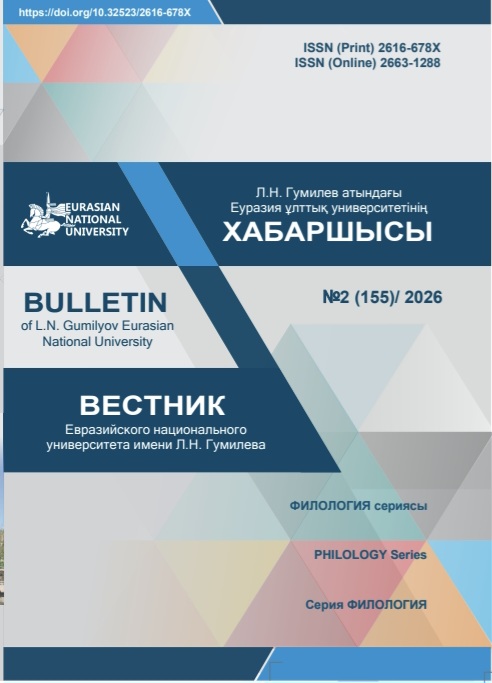
PERIPHRASIS IN LITERARY AND MEDIA DISCOURSE: LINGUISTIC REPRESENTATION OF THE NATIONAL AND CULTURAL CODE
Views: 304 / PDF downloads: 186
DOI:
https://doi.org/10.32523/2616-678X-2026-155-2-8-25Keywords:
periphrasis, linguopragmatics, media discourse, literary discourse, national-cultural code, linguistic representationAbstract
This paper examines the linguo‑pragmatic functions of periphrasis in Kazakh literary discourse and media discourse. Periphrasis is treated as an indirect descriptive naming strategy with strong nominative, expressive‑evaluative and euphemistic potential. The study aims to compare how periphrastic units are used in fiction and in journalistic texts and to identify their mechanisms of pragmatic influence on the addressee. The scholarly value of the research lies in approaching periphrasis not only as a stylistic trope that embellishes speech, but also as a discourse‑strategic, text‑forming and persuasive device. Its practical value is linked to media‑text editing, text interpretation, and the teaching of stylistics and media linguistics. Methodologically, the article follows an interpretive functional approach. Еxamples selected from Kazakh prose and periodical media texts are analysed through contextual reading, pragmatic interpretation, comparative description and functional classification. The findings show that aesthetic imagery and psychological characterisation dominate in literary discourse, whereas media discourse amplifies attention‑drawing, evaluative, euphemising, cliché‑forming and potentially manipulative functions. The study therefore clarifies the cross‑discursive nature of periphrasis and contributes to systematising secondary nomination patterns in contemporary Kazakh media language.
Downloads
Published
How to Cite
Issue
Section
License
Copyright (c) 2026 Bulletin of L.N. Gumilyov Eurasian National University. PHILOLOGY Series

This work is licensed under a Creative Commons Attribution-NonCommercial 4.0 International License.
Here is the academic English version suitable for publication on the journal website:
The academic journal “Bulletin of L.N. Gumilyov Eurasian National University. Philology Series” adheres to an Open Access policy for all published materials, based on the principle of free and equitable dissemination of scholarly knowledge. The Editorial Board believes that open access to research results contributes to the advancement of philological science, strengthens academic communication, and promotes the integration of national research into the international scientific community.
1. Free and Open Access
All articles published in the journal are made openly available on the official website of the journal and are accessible to all users without restrictions, registration, or payment.
Users are entitled to:
-
freely read and download materials;
-
copy and distribute the texts of publications;
-
print articles;
-
use materials for scientific and educational purposes, provided that proper attribution is given to the author(s) and the original source of publication.
2. Licensing
Journal materials are distributed under the terms of the Creative Commons Attribution-NonCommercial 4.0 International (CC BY-NC 4.0) license:
https://creativecommons.org/licenses/by-nc/4.0/
This license permits the use, copying, distribution, and adaptation of the materials for non-commercial purposes, provided that appropriate credit is given to the author(s) and a link to the original publication is included.
3. Benefits of Open Access
The Open Access policy ensures:
-
increased visibility and citation of scholarly publications;
-
prompt dissemination of research findings in the fields of philology, linguistics, literary studies, and translation studies;
-
expansion of international academic cooperation;
-
access for readers to up-to-date scientific information without financial or technical barriers.
The Editorial Board is committed to ensuring transparency in editorial processes, maintaining high standards of peer review, and providing broad accessibility to research outcomes in the field of philological studies.