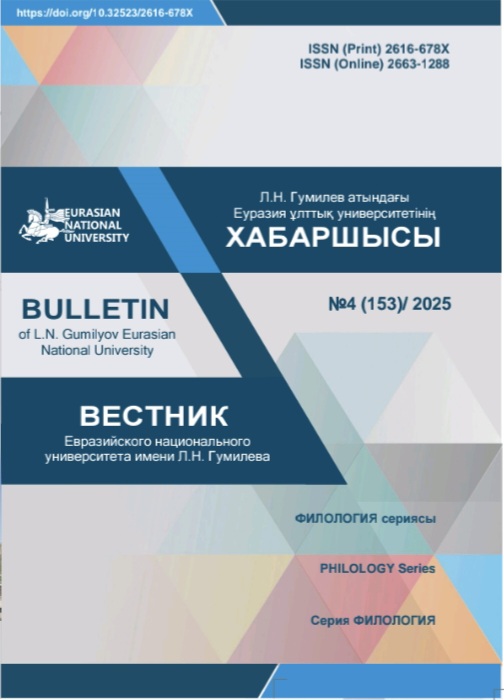
Communicative-pragmatic features of Kazakh humor: reflection on national values
Views: 387 / PDF downloads: 944
DOI:
https://doi.org/10.32523/2616-678X-2025-153-4-75-93Keywords:
Kazakh humor, communicative-pragmatic aspects, metaphors, intercultural comparisonAbstract
This study explores the role of humour in Kazakh social life, demonstrating how it facilitates the preservation and transmission of cultural knowledge. The main purpose of the study is to show that humor is not only entertainment but also a form of social interaction through which values, norms, and shared knowledge are passed from one generation to another. To address this question, the study relies on a set of different approaches. The material is read closely to see how certain stylistic features appear, the meanings hidden between the lines are examined, and the social purpose of each humorous example is considered. In addition, the Kazakh material is compared with humor from other cultures.
The analysis draws on a mixed set of materials. For this research, examples were collected from older oral humor as well as from online platforms where modern users post short, humorous remarks. Examining them side by side makes it clear that older humorous patterns still surface in online communication. These features allow speakers to comment on social issues in a subtle and culturally acceptable way. The novelty of the research lies in combining traditional and digital humor within one communicative-pragmatic framework, demonstrating how cultural codes remain stable even as modes of communication change.
Downloads
Published
How to Cite
Issue
Section
License
Here is the academic English version suitable for publication on the journal website:
The academic journal “Bulletin of L.N. Gumilyov Eurasian National University. Philology Series” adheres to an Open Access policy for all published materials, based on the principle of free and equitable dissemination of scholarly knowledge. The Editorial Board believes that open access to research results contributes to the advancement of philological science, strengthens academic communication, and promotes the integration of national research into the international scientific community.
1. Free and Open Access
All articles published in the journal are made openly available on the official website of the journal and are accessible to all users without restrictions, registration, or payment.
Users are entitled to:
-
freely read and download materials;
-
copy and distribute the texts of publications;
-
print articles;
-
use materials for scientific and educational purposes, provided that proper attribution is given to the author(s) and the original source of publication.
2. Licensing
Journal materials are distributed under the terms of the Creative Commons Attribution-NonCommercial 4.0 International (CC BY-NC 4.0) license:
https://creativecommons.org/licenses/by-nc/4.0/
This license permits the use, copying, distribution, and adaptation of the materials for non-commercial purposes, provided that appropriate credit is given to the author(s) and a link to the original publication is included.
3. Benefits of Open Access
The Open Access policy ensures:
-
increased visibility and citation of scholarly publications;
-
prompt dissemination of research findings in the fields of philology, linguistics, literary studies, and translation studies;
-
expansion of international academic cooperation;
-
access for readers to up-to-date scientific information without financial or technical barriers.
The Editorial Board is committed to ensuring transparency in editorial processes, maintaining high standards of peer review, and providing broad accessibility to research outcomes in the field of philological studies.