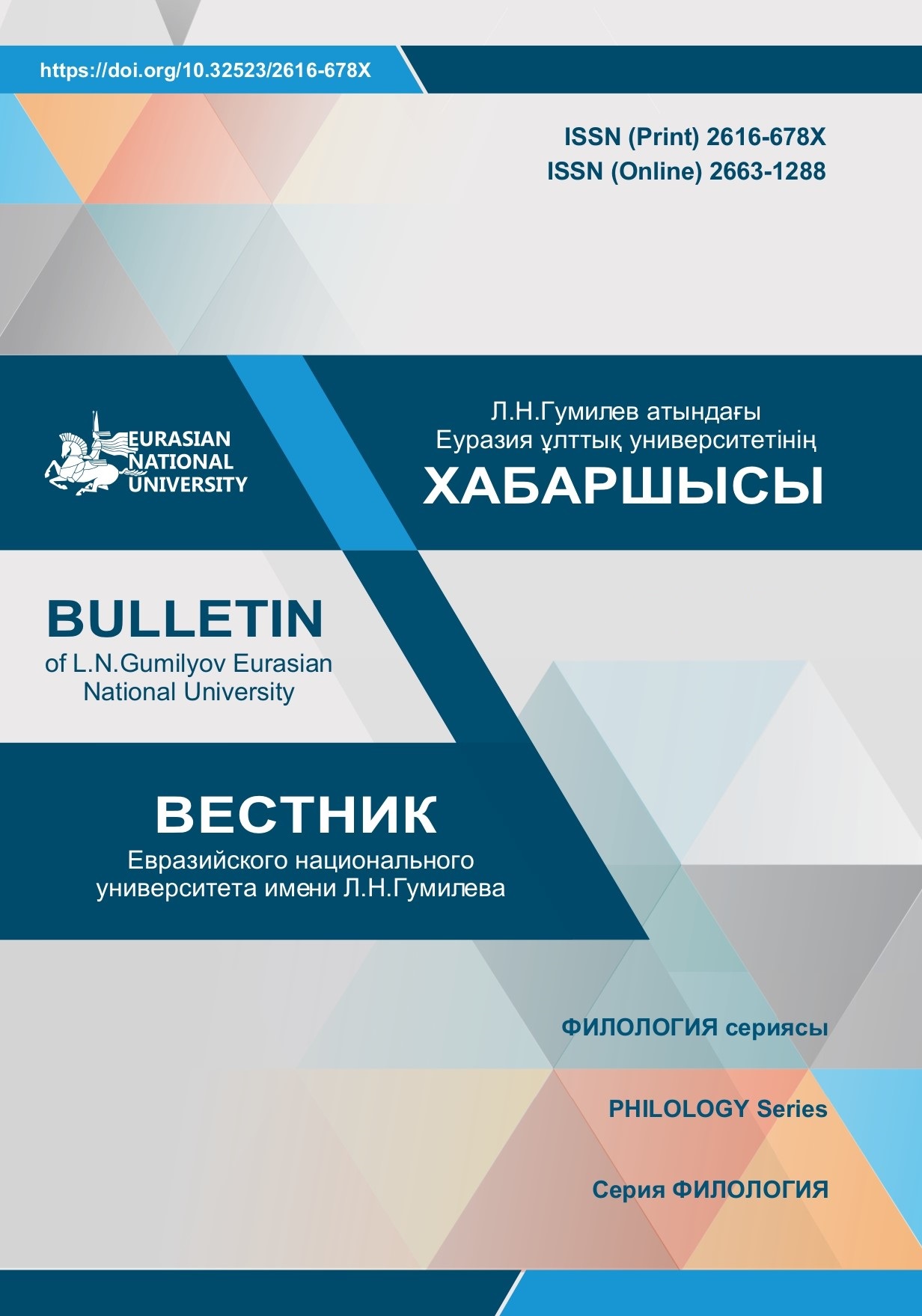
The national and cultural character of the concept «Woman»
Views: 546 / PDF downloads: 665
DOI:
https://doi.org/10.32523/2616-678X-2022-139-2-20-30Keywords:
worldview, concept, phraseological unit, phraseological fragment, cognitive modelAbstract
One of the topics that will forever be studied in science and society is the issue of women. Names related to the concept of «woman» in the knowledge of the Kazakh people, language units, lexico-phraseological, paremiological units, concepts formed in the concept of the people, data confirming the concept of «woman» in modern artistic texts, which allow us to recognize the taste, attitude, feelings, psychology, diverse features of Kazakh women, determine their place in Kazakh culture. The most important issue is the definition of the role and place of woman in the life of society, in national culture, in the linguistic and cultural direction of the language data that characterize her, and the interpretation of the lexical-semantic, conceptual content of the concept of woman in the context of the level of background knowledge.
The article considers the contribution of the phraseological system of the language to the modernization of the mentality inherent in a particular linguistic and cultural community. The concept of «woman» is based on the national character of the concept of woman as a whole, the linguistic and cultural features of the social consciousness and mentality of the two peoples, national values and views on the world, which are embodied in the phraseological fragment of the Kazakh world image. The research is aimed at a deeper understanding of the meaning of phraseological phrases used in the Kazakh language. Phraseological phrases indicate the place occupied by the female subject in modern society
Downloads
Published
How to Cite
Issue
Section
License
Here is the academic English version suitable for publication on the journal website:
The academic journal “Bulletin of L.N. Gumilyov Eurasian National University. Philology Series” adheres to an Open Access policy for all published materials, based on the principle of free and equitable dissemination of scholarly knowledge. The Editorial Board believes that open access to research results contributes to the advancement of philological science, strengthens academic communication, and promotes the integration of national research into the international scientific community.
1. Free and Open Access
All articles published in the journal are made openly available on the official website of the journal and are accessible to all users without restrictions, registration, or payment.
Users are entitled to:
-
freely read and download materials;
-
copy and distribute the texts of publications;
-
print articles;
-
use materials for scientific and educational purposes, provided that proper attribution is given to the author(s) and the original source of publication.
2. Licensing
Journal materials are distributed under the terms of the Creative Commons Attribution-NonCommercial 4.0 International (CC BY-NC 4.0) license:
https://creativecommons.org/licenses/by-nc/4.0/
This license permits the use, copying, distribution, and adaptation of the materials for non-commercial purposes, provided that appropriate credit is given to the author(s) and a link to the original publication is included.
3. Benefits of Open Access
The Open Access policy ensures:
-
increased visibility and citation of scholarly publications;
-
prompt dissemination of research findings in the fields of philology, linguistics, literary studies, and translation studies;
-
expansion of international academic cooperation;
-
access for readers to up-to-date scientific information without financial or technical barriers.
The Editorial Board is committed to ensuring transparency in editorial processes, maintaining high standards of peer review, and providing broad accessibility to research outcomes in the field of philological studies.