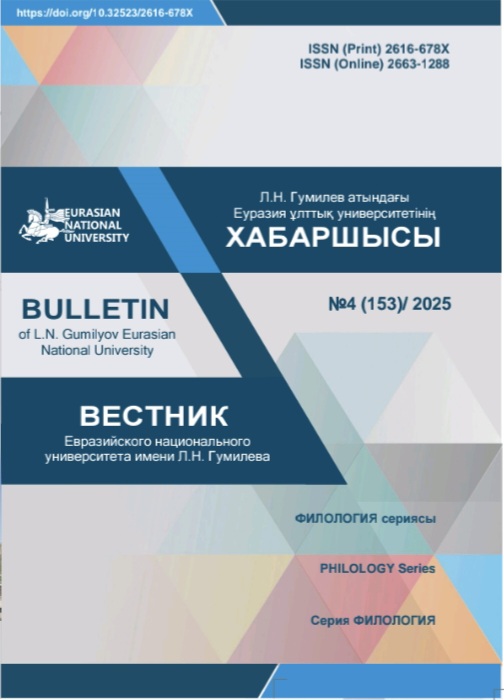
The problem of overcoming Kazakh non-equivalence in literary translation: a review of research and approaches
Views: 408 / PDF downloads: 278
DOI:
https://doi.org/10.32523/2616-678X-2025-153-4-268-278Keywords:
non-equivalent vocabulary, realia, translation, Kazakh non-equivalence, literary translationAbstract
This article analyses the work of local researchers studying the issue of Kazakh non-equivalence. It examines the ways of overcoming non-equivalence in the literary translation of works of Kazakh authors into Russian and English. A review of the key works published in international and local scientific journals over the past five years, from 2020 to 2024 inclusive, is provided. The relevance of the study is determined by the need to preserve the cultural and aesthetic features of the original text when adapting it for a reader in another linguocultural environment. The article focuses on the need for a careful approach to the transfer of non-equivalent vocabulary in the process of literary translation. Based on the full-text analysis and synthesis of the results, it can be concluded that various methods, such as transcription, transliteration, calque, descriptive translation, explanatory footnotes, approximate translation, replacement, and omission, can be used to convey Kazakh non-equivalent vocabulary in literary translation into Russian and English. In the future, we suggest conducting research on how the target audience perceives the translation.
Downloads
Published
How to Cite
Issue
Section
License
Here is the academic English version suitable for publication on the journal website:
The academic journal “Bulletin of L.N. Gumilyov Eurasian National University. Philology Series” adheres to an Open Access policy for all published materials, based on the principle of free and equitable dissemination of scholarly knowledge. The Editorial Board believes that open access to research results contributes to the advancement of philological science, strengthens academic communication, and promotes the integration of national research into the international scientific community.
1. Free and Open Access
All articles published in the journal are made openly available on the official website of the journal and are accessible to all users without restrictions, registration, or payment.
Users are entitled to:
-
freely read and download materials;
-
copy and distribute the texts of publications;
-
print articles;
-
use materials for scientific and educational purposes, provided that proper attribution is given to the author(s) and the original source of publication.
2. Licensing
Journal materials are distributed under the terms of the Creative Commons Attribution-NonCommercial 4.0 International (CC BY-NC 4.0) license:
https://creativecommons.org/licenses/by-nc/4.0/
This license permits the use, copying, distribution, and adaptation of the materials for non-commercial purposes, provided that appropriate credit is given to the author(s) and a link to the original publication is included.
3. Benefits of Open Access
The Open Access policy ensures:
-
increased visibility and citation of scholarly publications;
-
prompt dissemination of research findings in the fields of philology, linguistics, literary studies, and translation studies;
-
expansion of international academic cooperation;
-
access for readers to up-to-date scientific information without financial or technical barriers.
The Editorial Board is committed to ensuring transparency in editorial processes, maintaining high standards of peer review, and providing broad accessibility to research outcomes in the field of philological studies.