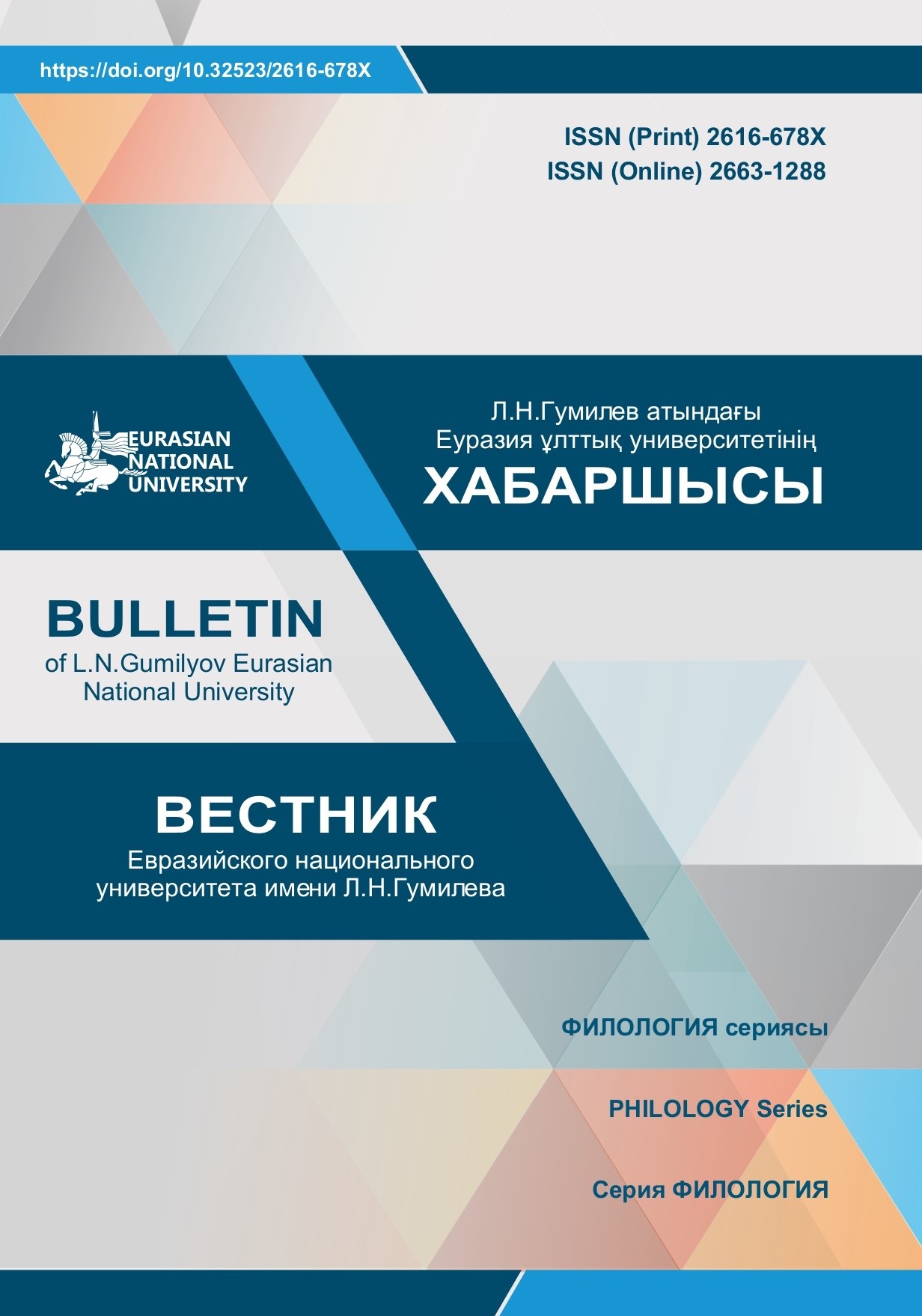
The author and personality concept in a literary work
Views: 411 / PDF downloads: 357
DOI:
https://doi.org/10.32523/2616-678X-2024-147-2-217-227Keywords:
personality concept, novel, character,, image, hero, authorAbstract
The article deals with the concept of the author and personality in the literary work based on the novels The last duty by A. Nurpeyisov and Prisoner of the Glory prison, It’s too early to sing, There is a paradise on Earth by K. Zhienbai. Currently, the study of the person and related issues in literature is not limited to the genre, the work structure or the ideological content, but it is considered from the point of view of the author’s and the person’s literary concept. According to scientists, the literary concept of personality is one of the main principles of the literary analysis. In this model of analysis, it is possible to recognize all the heroes created by the writer. If the author’s concept expresses the writer’s assessment of the life phenomena, his philosophical view on the integrity of the world, the literary concept of the person determines the ways of its realization. A. Nurpeyisov (1924-2022) is an outstanding figure of Kazakh literature. His novel-dialogue The last duty is a significant literary work of the independence period. The whole novel is based on the stream of consciousness. The literary position of the author is assigned to the image of Zhadiger. Self-sacrifice and responsibility, boundless love for the native land are its main characteristics. The spiritual integrity of the author is visible by images of Zhadiger and Elaman (“Blood and Sweat” trilogy). Neither Elaman nor Zhadiger could tolerate extreme abuse. The main principles of the literary concept of personality such as: the hero’s desire for selfawareness in a difficult moment, his own attitude to life and strong bonds, the place of a person in society and human values are analyzed. K. Zhienbai’s novels describing the
environmental consequences of Aral and Baikonur region are his continuous works. Themes, time and places of events are common. Although the professions and services of the heroes are different, they are close people, natives of the same region. Each of them deeply feels the consequences of ecology. But they do not leave their homeland and migrate to other regions. His heroes are living in that region and intend to develop their native land. They are innovative people who have felt the breath of modern times. In the author’s description, several contrasting life scenes intersect in one region. Aral is a region of human environmental suffering, Baikonur is a world spaceport; Korkyt ata mausoleum is a sacred place of Turkiс people. The writer creatively develops this
contrast in his works.
Downloads
Published
How to Cite
Issue
Section
License
Here is the academic English version suitable for publication on the journal website:
The academic journal “Bulletin of L.N. Gumilyov Eurasian National University. Philology Series” adheres to an Open Access policy for all published materials, based on the principle of free and equitable dissemination of scholarly knowledge. The Editorial Board believes that open access to research results contributes to the advancement of philological science, strengthens academic communication, and promotes the integration of national research into the international scientific community.
1. Free and Open Access
All articles published in the journal are made openly available on the official website of the journal and are accessible to all users without restrictions, registration, or payment.
Users are entitled to:
-
freely read and download materials;
-
copy and distribute the texts of publications;
-
print articles;
-
use materials for scientific and educational purposes, provided that proper attribution is given to the author(s) and the original source of publication.
2. Licensing
Journal materials are distributed under the terms of the Creative Commons Attribution-NonCommercial 4.0 International (CC BY-NC 4.0) license:
https://creativecommons.org/licenses/by-nc/4.0/
This license permits the use, copying, distribution, and adaptation of the materials for non-commercial purposes, provided that appropriate credit is given to the author(s) and a link to the original publication is included.
3. Benefits of Open Access
The Open Access policy ensures:
-
increased visibility and citation of scholarly publications;
-
prompt dissemination of research findings in the fields of philology, linguistics, literary studies, and translation studies;
-
expansion of international academic cooperation;
-
access for readers to up-to-date scientific information without financial or technical barriers.
The Editorial Board is committed to ensuring transparency in editorial processes, maintaining high standards of peer review, and providing broad accessibility to research outcomes in the field of philological studies.