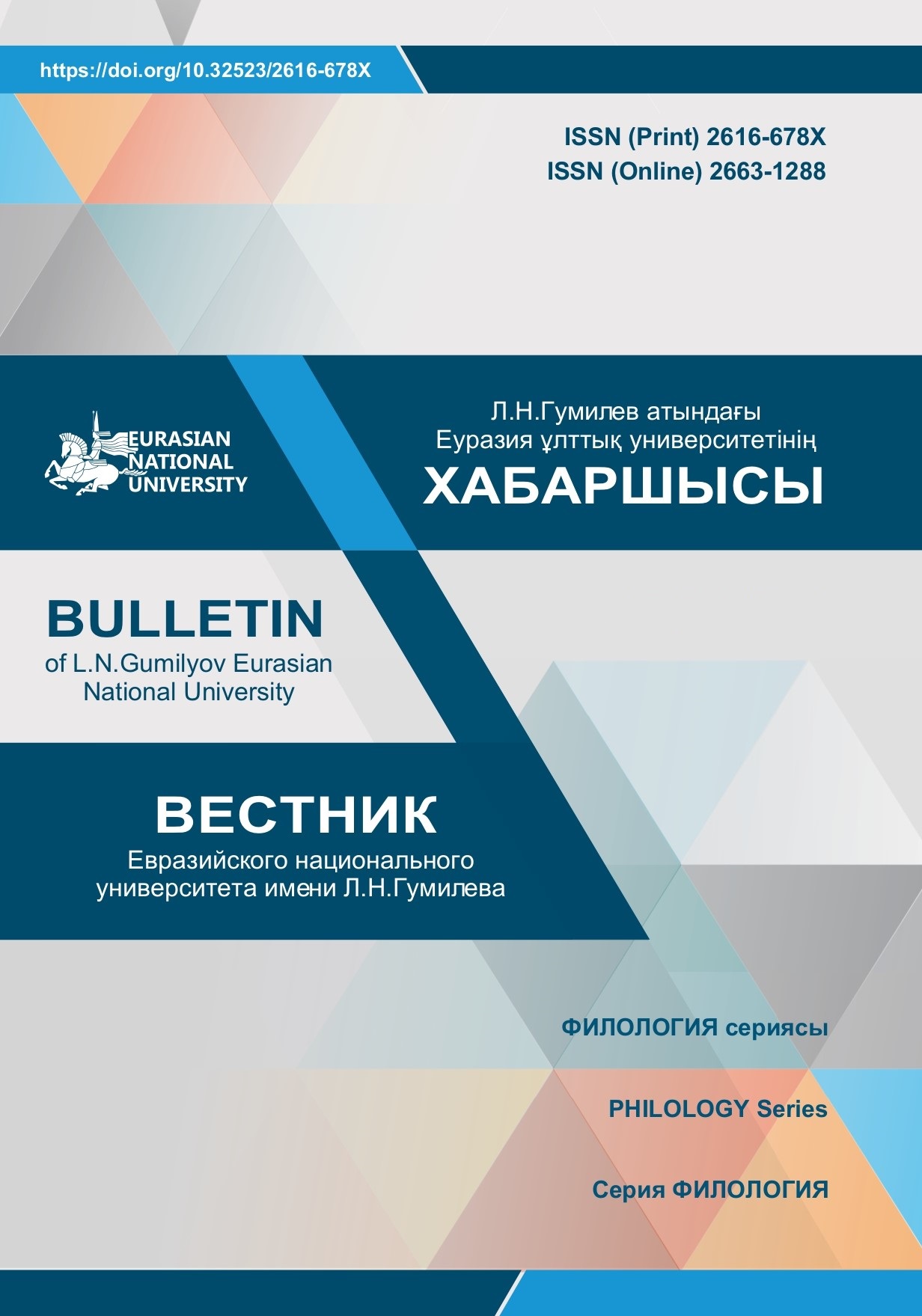
Morphology of poetry (on the example of Abai's poems)
Views: 477 / PDF downloads: 433
DOI:
https://doi.org/10.32523/2616-678X-2023-144-3-188-202Keywords:
poetry, morphology, formalism, structuralism, symbol, actant, cyclingAbstract
В статье проводится анализ текста поэзии в морфологическом аспекте на примере стихов Абая.
Если семиотический подход структурализма предполагает проявление функции символа в структуре художественного текста, то знак, который несет в себе художественно-эстетическую задачу, приобретает символический, детальный, образный характер. Эти характеристики становятся объектами исследований в различных направлениях как части текста, которые становятся единым целым. Объектом семиотического анализа является знаковая и вытекающая из нее образная структура в тексте. В этом направлении исследования преобладает эффективность морфологического подхода. Использование термина «морфология» применительно к литературе не ново, в частности, для мирового литературоведения это уже существующее понятие. Это понятие, вошедшее в научный обиход в фольклористике и литературоведении в начале ХХ века, достигло новых выводов с индивидуализацией и обобщением всех деталей художественного произведения. Вообще известно, что одной из основ структурализма является русский формализм, а другой – пропповая морфология. Следовательно, при руководствовании литературной морфологией нельзя упускать из виду и историческую роль формализма, заложившего фундамент структурного анализа. Основной целью данной статьи является рассмотрение детализации и целостности структуры текста с помощью принципов анализа литературной морфологии. Для достижения этой цели при анализе стихов Абая определяется актантная, образная структура. Через логические связи и сходства в данной частичной структуре демонстрируется закономерность целостности и формулируется мысль о цикле стихов.
Downloads
Published
How to Cite
Issue
Section
License
Here is the academic English version suitable for publication on the journal website:
The academic journal “Bulletin of L.N. Gumilyov Eurasian National University. Philology Series” adheres to an Open Access policy for all published materials, based on the principle of free and equitable dissemination of scholarly knowledge. The Editorial Board believes that open access to research results contributes to the advancement of philological science, strengthens academic communication, and promotes the integration of national research into the international scientific community.
1. Free and Open Access
All articles published in the journal are made openly available on the official website of the journal and are accessible to all users without restrictions, registration, or payment.
Users are entitled to:
-
freely read and download materials;
-
copy and distribute the texts of publications;
-
print articles;
-
use materials for scientific and educational purposes, provided that proper attribution is given to the author(s) and the original source of publication.
2. Licensing
Journal materials are distributed under the terms of the Creative Commons Attribution-NonCommercial 4.0 International (CC BY-NC 4.0) license:
https://creativecommons.org/licenses/by-nc/4.0/
This license permits the use, copying, distribution, and adaptation of the materials for non-commercial purposes, provided that appropriate credit is given to the author(s) and a link to the original publication is included.
3. Benefits of Open Access
The Open Access policy ensures:
-
increased visibility and citation of scholarly publications;
-
prompt dissemination of research findings in the fields of philology, linguistics, literary studies, and translation studies;
-
expansion of international academic cooperation;
-
access for readers to up-to-date scientific information without financial or technical barriers.
The Editorial Board is committed to ensuring transparency in editorial processes, maintaining high standards of peer review, and providing broad accessibility to research outcomes in the field of philological studies.