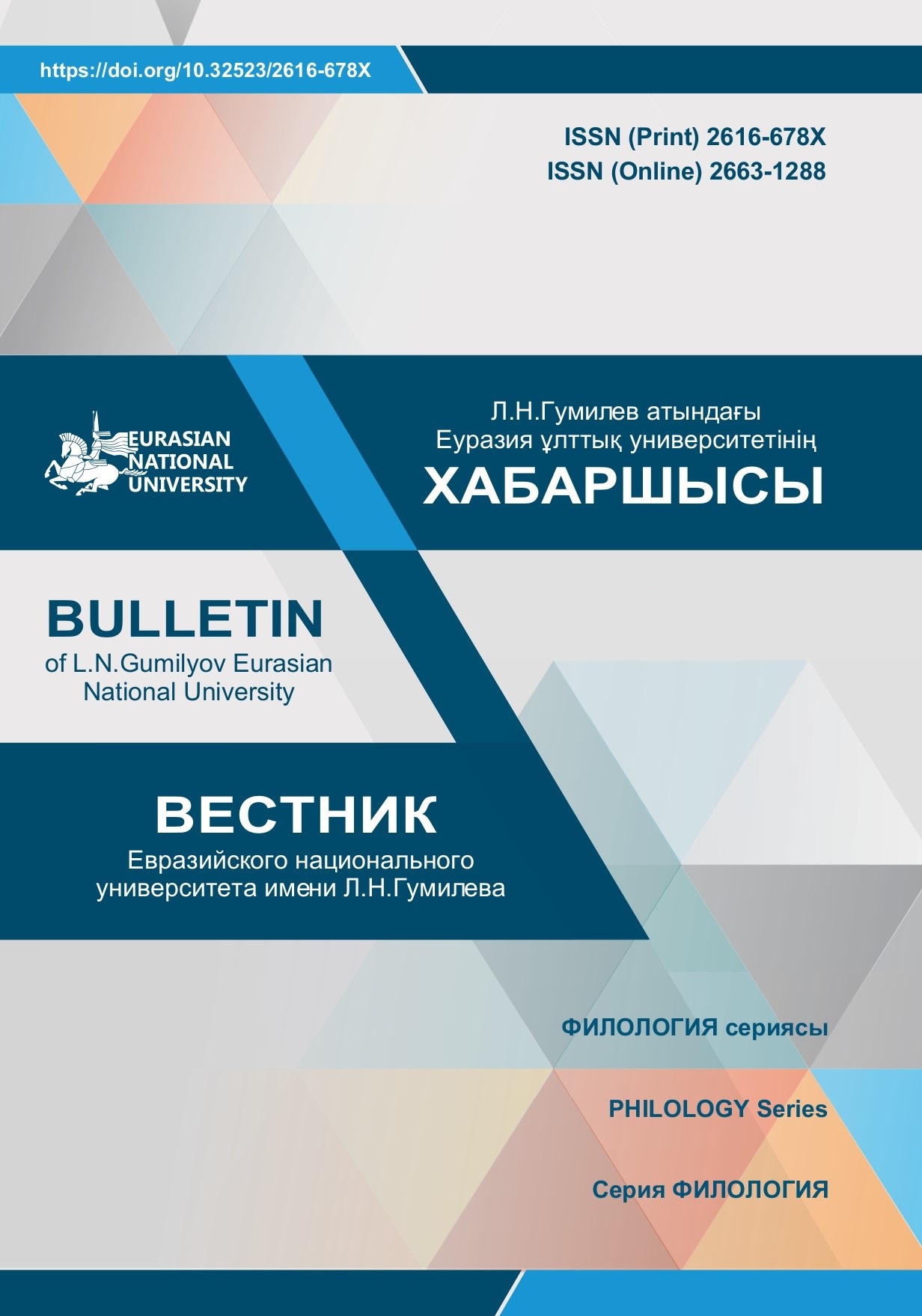
Smagul Saduakasuly’s short stories: integration of imagery and historical principles
Views: 367 / PDF downloads: 362
DOI:
https://doi.org/10.32523/2616-678X-2021-137-4-86-96Keywords:
Alash literature, national idea, imagery and historical principles, image system, colonialism, publicist warble, reader’s cognition, conflict of viewsAbstract
The short stories «Orten», «Salmakbai, Makhambet», «Aptonomia» by Smagul Saduakasuly
(Sadvokasov), famous in the fiction of the 20s of the twentieth century with the stories «Salmakbai – Sagyndyk»,
«Kulpash», «Kumis konyrau», the novel «Sarsenbek», differ in both imagery and historical nature.
The author of these works relating to the period of Alash literature is not just a writer, but a young, but
already intellectually mature political figure who took up the pen not so much by inspiration as pursuing
enlightening goals. For example, for this reason Alash leader Alikhan Bukeikhan became a competent publicist
and a constructive literary critic in his political career. This quality was also characteristic of Smagul Saduakasuly.
The dream of youth, the views of the intelligentsia on popular and revolutionary problems in a critical historical period, the protection of the natural interests of the people under Bolshevism, socio-political, socio-economic
changes - these are the primary aim of the writer.
Colonialism is a deep-rooted cruel phenomenon that has existed through injustice, meanness and violence.
This perfidy, which brought tragedy to many peoples of the world (in the lexicon of Alash “juan judyryq” -
thick fist), kept the Kazakh people to ineffable torment and set back the development of equality and freedom.
Smagul, whose mind and heart aspired to justice from a young age, understood both societies deprived of
freedom, deeply delving into their negative and some positive sides.
As a representative of Kazakh literature of the first quarter of the twentieth century, proceeding from the
traditions of World and Russian literature, folklore, Smagul Saduakasuly relied on imagery and historical
principles and on the ways of interaction of these two creative principles mastered the skill of writing.
The article examines and analyzes the research and achievements of S. Saduakas-uly in the genre of short
stories that have remained outside the history of literature.
Downloads
Published
How to Cite
Issue
Section
License
Here is the academic English version suitable for publication on the journal website:
The academic journal “Bulletin of L.N. Gumilyov Eurasian National University. Philology Series” adheres to an Open Access policy for all published materials, based on the principle of free and equitable dissemination of scholarly knowledge. The Editorial Board believes that open access to research results contributes to the advancement of philological science, strengthens academic communication, and promotes the integration of national research into the international scientific community.
1. Free and Open Access
All articles published in the journal are made openly available on the official website of the journal and are accessible to all users without restrictions, registration, or payment.
Users are entitled to:
-
freely read and download materials;
-
copy and distribute the texts of publications;
-
print articles;
-
use materials for scientific and educational purposes, provided that proper attribution is given to the author(s) and the original source of publication.
2. Licensing
Journal materials are distributed under the terms of the Creative Commons Attribution-NonCommercial 4.0 International (CC BY-NC 4.0) license:
https://creativecommons.org/licenses/by-nc/4.0/
This license permits the use, copying, distribution, and adaptation of the materials for non-commercial purposes, provided that appropriate credit is given to the author(s) and a link to the original publication is included.
3. Benefits of Open Access
The Open Access policy ensures:
-
increased visibility and citation of scholarly publications;
-
prompt dissemination of research findings in the fields of philology, linguistics, literary studies, and translation studies;
-
expansion of international academic cooperation;
-
access for readers to up-to-date scientific information without financial or technical barriers.
The Editorial Board is committed to ensuring transparency in editorial processes, maintaining high standards of peer review, and providing broad accessibility to research outcomes in the field of philological studies.