Phraseologisms related to the names of hats in the Kazakh and Turkish languages: Ethnolinguistic nature
Views: 545 / PDF downloads: 192
DOI:
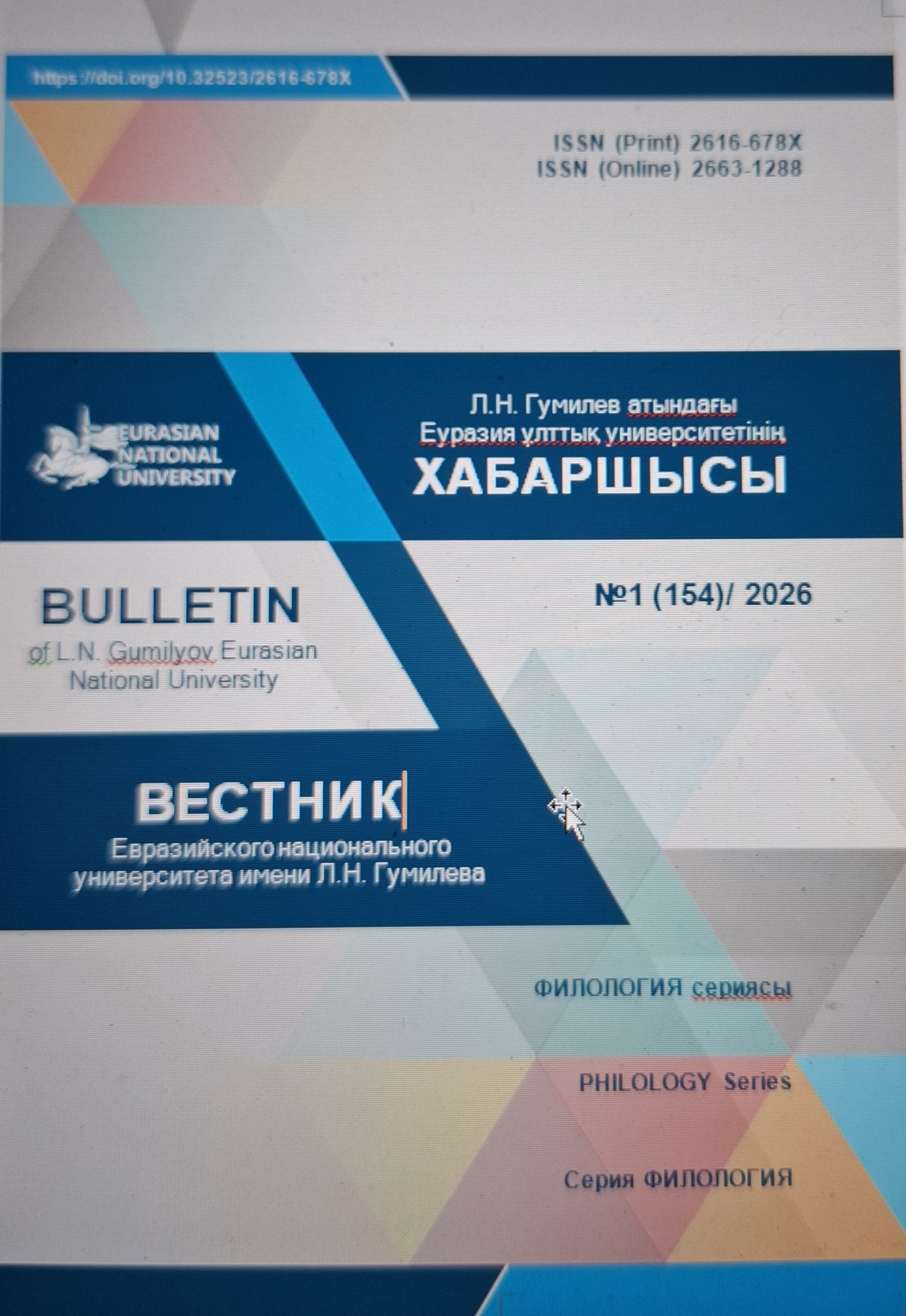
https://doi.org/10.32523/2616-678X-2026-154-1-141-153Keywords:
phraseology, ethnolinguistics, names of hats, borik, fes, cultural code, comparative analysis, stable phraseAbstract
The article analyzes the content features, semantic structure and cultural background of phraseology related to the names of hats in the Kazakh and Turkish languages, their similarities and differences are considered from an ethnolinguistic point of view. The research work aims to contribute to the disclosure of common linguistic archetypes and cultural continuity of the Turkic peoples, as well as to clarify the reflection of phraseology in relation to national identity. As an object of study, stable expressions derived from traditional headdress names such as Berik, turban, fes, takke, külah, which are widely used in the languages of both peoples, were taken. Especially in the composition of phraseology, the direction of action (for example, a Burk was thrown into the air, a Burk was hit on the ground) and its connection with emotions are characterized by close interweaving with cultural content. At the same time, it is proved that stable expressions in Turkish, such as Fesini air Atatürk, Takke çalı, kel göldü, Küllah takmak, also have a symbolic meaning, expressing the national attitude and norms of social attitudes. As a result of the study, in addition to similarities in the structure and content of Kazakh and Turkish phraseology, differences are also revealed that reflect the historical and cultural identity of each nation. This, in turn, will allow us to identify the ethnolinguistic commonality of Turkic languages and reveal the cognitive potential of phraseology. The methods of comparative, semantic and ethnolinguistic analysis used in the article allow us to systematically differentiate the phraseological fund of the two peoples. Through this, important scientific conclusions are made aimed at recognizing the national identity, cultural code, historical memory and system of cognition through language.
Downloads
Published
Versions
- 2026-09-23 (2)
- 2026-03-31 (1)
How to Cite
Issue
Section
License
Copyright (c) 2026 Bulletin of L.N. Gumilyov Eurasian National University. PHILOLOGY Series

This work is licensed under a Creative Commons Attribution-NonCommercial 4.0 International License.
Here is the academic English version suitable for publication on the journal website:
The academic journal “Bulletin of L.N. Gumilyov Eurasian National University. Philology Series” adheres to an Open Access policy for all published materials, based on the principle of free and equitable dissemination of scholarly knowledge. The Editorial Board believes that open access to research results contributes to the advancement of philological science, strengthens academic communication, and promotes the integration of national research into the international scientific community.
1. Free and Open Access
All articles published in the journal are made openly available on the official website of the journal and are accessible to all users without restrictions, registration, or payment.
Users are entitled to:
-
freely read and download materials;
-
copy and distribute the texts of publications;
-
print articles;
-
use materials for scientific and educational purposes, provided that proper attribution is given to the author(s) and the original source of publication.
2. Licensing
Journal materials are distributed under the terms of the Creative Commons Attribution-NonCommercial 4.0 International (CC BY-NC 4.0) license:
https://creativecommons.org/licenses/by-nc/4.0/
This license permits the use, copying, distribution, and adaptation of the materials for non-commercial purposes, provided that appropriate credit is given to the author(s) and a link to the original publication is included.
3. Benefits of Open Access
The Open Access policy ensures:
-
increased visibility and citation of scholarly publications;
-
prompt dissemination of research findings in the fields of philology, linguistics, literary studies, and translation studies;
-
expansion of international academic cooperation;
-
access for readers to up-to-date scientific information without financial or technical barriers.
The Editorial Board is committed to ensuring transparency in editorial processes, maintaining high standards of peer review, and providing broad accessibility to research outcomes in the field of philological studies.