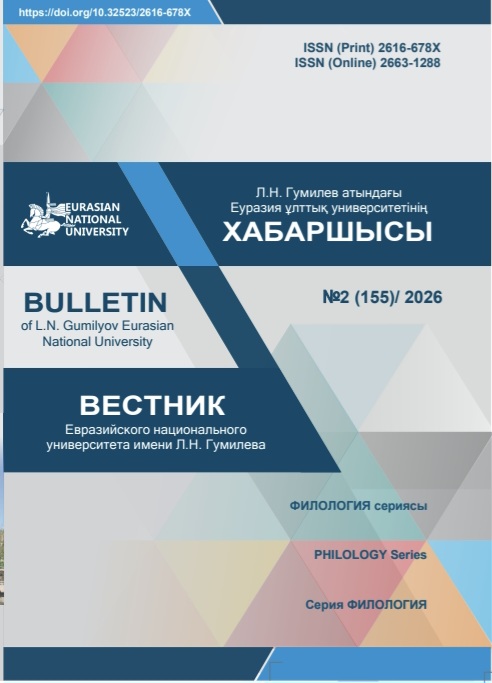
LINGUOCULTURAL CONCEPTUALIZATION OF “DEBT” AND “OBLIGATION” IN KAZAKH AND ENGLISH: A COMPARATIVE STUDY
Views: 217 / PDF downloads: 116
DOI:
https://doi.org/10.32523/2616-678X-2026-155-2-56-69Keywords:
debt, obligation, Kazakh worldview, English culture, moral responsibility, social norms, intercultural communicationAbstract
This study delves into the linguocultural features of the terms "debt" and "obligation" in Kazakh and English cultural models. It investigates how debt and obligation as concepts are built on the basis of anchoring moral values, social practices, and local history, particular to the specific culture. Despite debt and obligation being universal concepts, their meanings demonstrate extreme cultural specificity and represent various worldviews and moral requirements. Qaryz (debt) and paryz (obligation) in Kazakh tradition are very tightly connected with collective identity, social solidarity, and robust family and neighborhood bonds. They are the pillars of social norms of solidarity, generosity, and communal harmony.
In contrast, in English-speaking cultures, debt and obligation can be equated with personal responsibility, legal obligation, and contractual duty. English language terminology is individualistic in nature, putting stress on personal duty, rights, and autonomy rather than collective duty. This current study uses comparative semantic and contextual analysis to explore how such culturally embedded models are encoded in language and how they influence behavior and expectations in interpersonal relationships across various sociocultural contexts. The results enhance our knowledge of cross-cultural communication and the role of language in representing moral and social norms.
Downloads
Published
How to Cite
Issue
Section
License
Copyright (c) 2026 Bulletin of L.N. Gumilyov Eurasian National University. PHILOLOGY Series

This work is licensed under a Creative Commons Attribution-NonCommercial 4.0 International License.
Here is the academic English version suitable for publication on the journal website:
The academic journal “Bulletin of L.N. Gumilyov Eurasian National University. Philology Series” adheres to an Open Access policy for all published materials, based on the principle of free and equitable dissemination of scholarly knowledge. The Editorial Board believes that open access to research results contributes to the advancement of philological science, strengthens academic communication, and promotes the integration of national research into the international scientific community.
1. Free and Open Access
All articles published in the journal are made openly available on the official website of the journal and are accessible to all users without restrictions, registration, or payment.
Users are entitled to:
-
freely read and download materials;
-
copy and distribute the texts of publications;
-
print articles;
-
use materials for scientific and educational purposes, provided that proper attribution is given to the author(s) and the original source of publication.
2. Licensing
Journal materials are distributed under the terms of the Creative Commons Attribution-NonCommercial 4.0 International (CC BY-NC 4.0) license:
https://creativecommons.org/licenses/by-nc/4.0/
This license permits the use, copying, distribution, and adaptation of the materials for non-commercial purposes, provided that appropriate credit is given to the author(s) and a link to the original publication is included.
3. Benefits of Open Access
The Open Access policy ensures:
-
increased visibility and citation of scholarly publications;
-
prompt dissemination of research findings in the fields of philology, linguistics, literary studies, and translation studies;
-
expansion of international academic cooperation;
-
access for readers to up-to-date scientific information without financial or technical barriers.
The Editorial Board is committed to ensuring transparency in editorial processes, maintaining high standards of peer review, and providing broad accessibility to research outcomes in the field of philological studies.