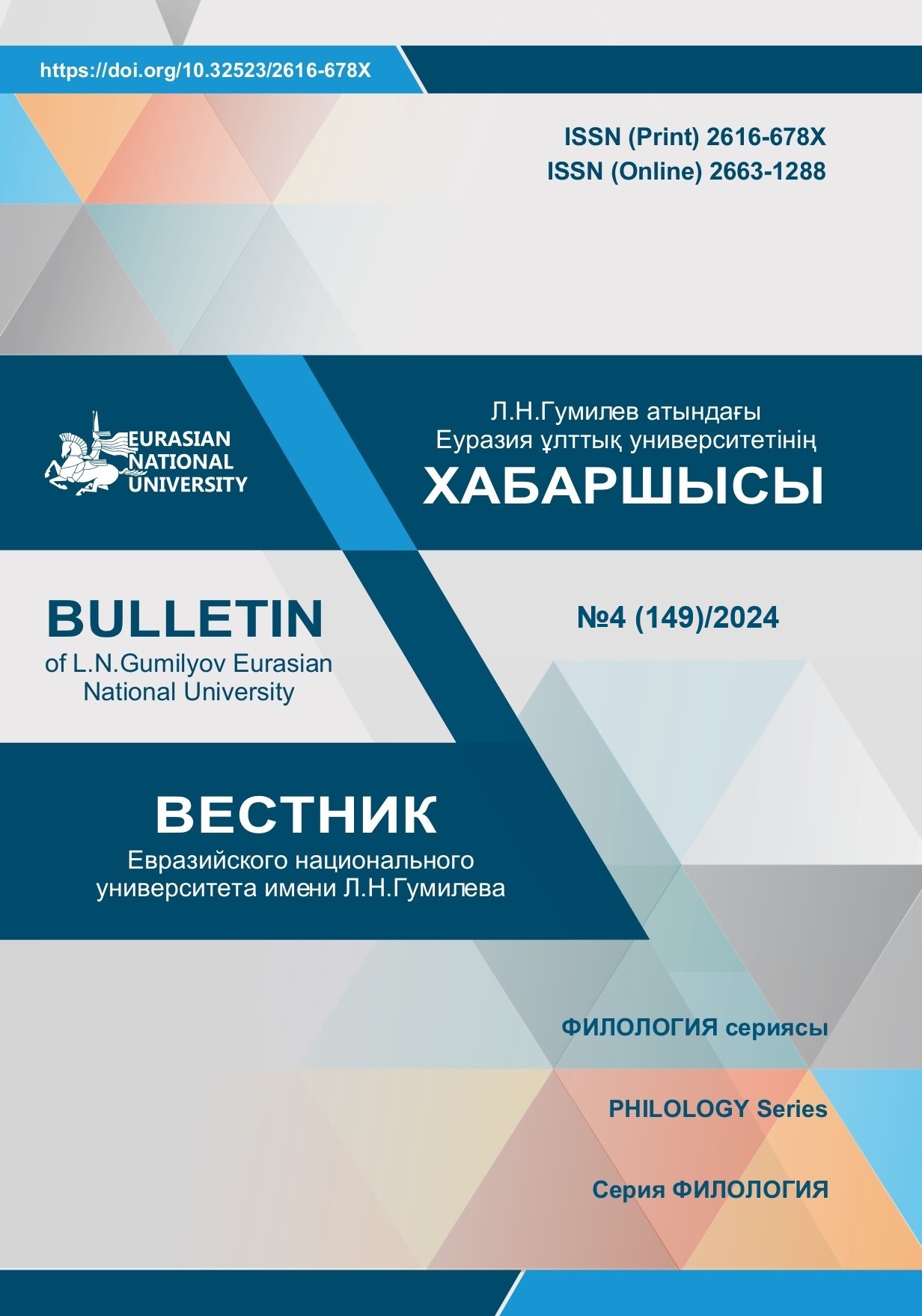
Ethno-linguocultural features of speech etiquette in Kazakh and English languages
Views: 521 / PDF downloads: 584
DOI:
https://doi.org/10.32523/2616-678X-2024-149-4-8-21Keywords:
language culture, speech etiquette, Kazakh language, English language, communication.Abstract
The article is devoted to the identification of linguocultural features of speech etiquette in Kazakh and English languages. Speech etiquette consists of stereotypical language formulas used in a speech act and, if necessary, in communication.
The aim of the study is to identify ethno-linguistic and linguocultural features of speech etiquette formulas in Kazakh and English languages. To implement this goal, samples of etiquette units in Kazakh and English - greetings, farewells, salutations, condolences, congratulations and wishes, addresses - were selected and analysed according to the nature of application, ethno-linguo-cultural character.
Based on the rational methods and techniques used in the study, it has been proved that the patterns of greeting and farewell in Kazakh are based on ethnic cognition. It was also determined that in Kazakh greeting one dialogue rejoinder consists of several sentences. This reflects the national ethnomental specificity. In contrast, the pattern of greetings in English etiquette is short, concise and interrogative sentences corresponding to the ethnocultural specificity of the nation.
It was found that farewell patterns are frequently used in the speech etiquette of both languages and their place is constant and the types are numerous. The thematic group of farewell patterns in English etiquette is defined and systematised. The features in the greeting and address patterns are analysed, and the types of politeness level in English etiquette are analysed on the basis of specific examples.
The theoretical significance of the study lies in the fact that the research contributes to the development of comparative linguocultural studies, the theory of intercultural communication and linguopragmatics, clarification and description of the concept of ‘etiquette model of behaviour’.
Practical significance of the work consists in the possibility of using the obtained results in the courses of general linguistics, intercultural communication, lexicology and stylistics of English and Kazakh languages, special courses on linguoculturology and pragmalinguistics, practice of teaching English and Kazakh as a foreign language.
Downloads
Published
How to Cite
Issue
Section
License
Here is the academic English version suitable for publication on the journal website:
The academic journal “Bulletin of L.N. Gumilyov Eurasian National University. Philology Series” adheres to an Open Access policy for all published materials, based on the principle of free and equitable dissemination of scholarly knowledge. The Editorial Board believes that open access to research results contributes to the advancement of philological science, strengthens academic communication, and promotes the integration of national research into the international scientific community.
1. Free and Open Access
All articles published in the journal are made openly available on the official website of the journal and are accessible to all users without restrictions, registration, or payment.
Users are entitled to:
-
freely read and download materials;
-
copy and distribute the texts of publications;
-
print articles;
-
use materials for scientific and educational purposes, provided that proper attribution is given to the author(s) and the original source of publication.
2. Licensing
Journal materials are distributed under the terms of the Creative Commons Attribution-NonCommercial 4.0 International (CC BY-NC 4.0) license:
https://creativecommons.org/licenses/by-nc/4.0/
This license permits the use, copying, distribution, and adaptation of the materials for non-commercial purposes, provided that appropriate credit is given to the author(s) and a link to the original publication is included.
3. Benefits of Open Access
The Open Access policy ensures:
-
increased visibility and citation of scholarly publications;
-
prompt dissemination of research findings in the fields of philology, linguistics, literary studies, and translation studies;
-
expansion of international academic cooperation;
-
access for readers to up-to-date scientific information without financial or technical barriers.
The Editorial Board is committed to ensuring transparency in editorial processes, maintaining high standards of peer review, and providing broad accessibility to research outcomes in the field of philological studies.