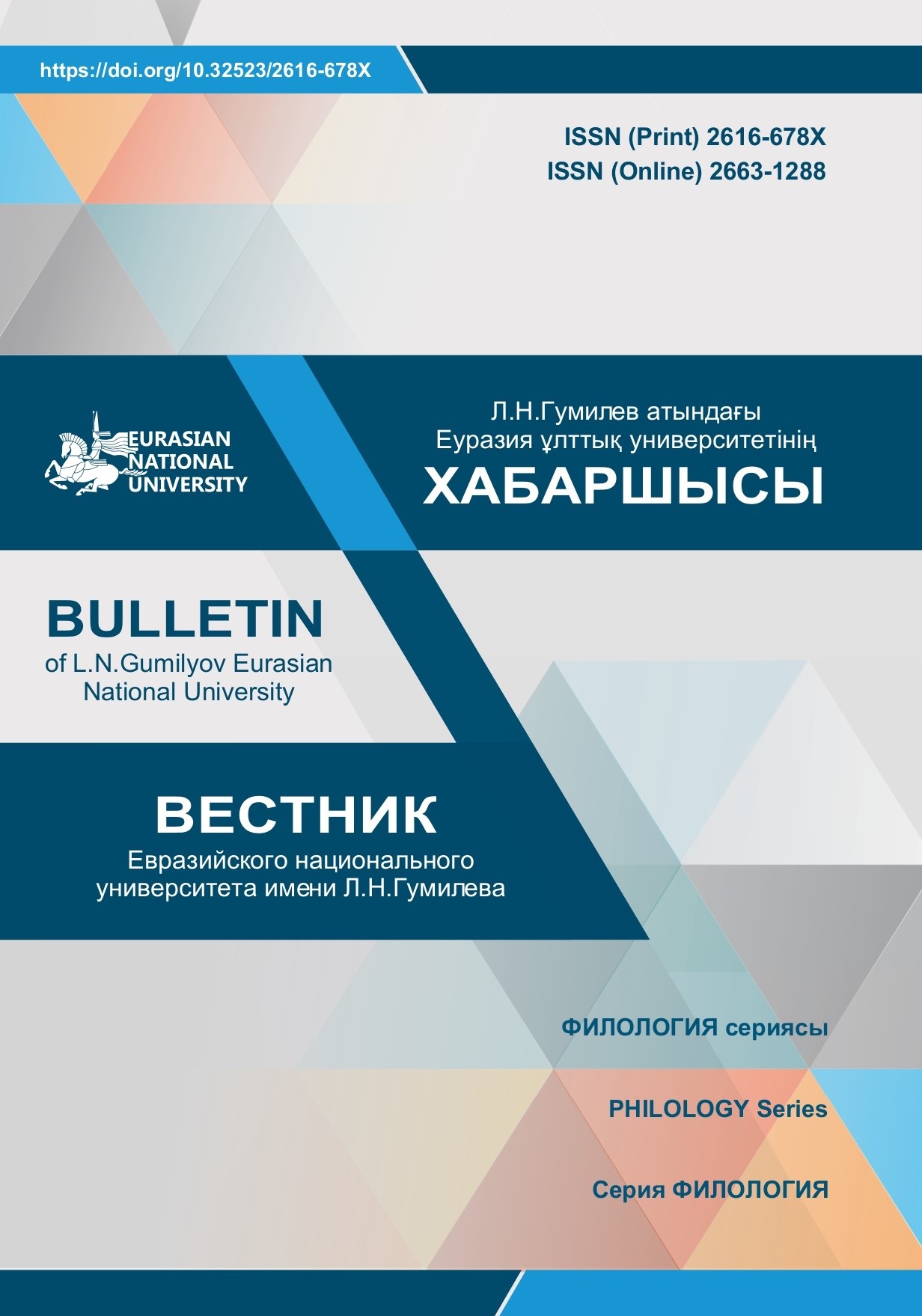
Basic vocabulary of an extinct language (Khoton language in Mongolia)
Views: 551 / PDF downloads: 297
DOI:
https://doi.org/10.32523/2616-678X-2024-147-2-68-80Keywords:
extinct language, Khoton, Turkic languages, Swadesh lists, basic vocabulary, semantic category.Abstract
This article presents the findings of the initial phase of studying the Khoton language, which
is one of the extinct languages and is not included in the list of world languages.
Previous researchers of Khoton considered it only in the historical and ethnological aspect. Therefore, the peculiarity of this work is that the language of the ethnic group is taken as a special object of research.
The Khotons living in Mongolia (in Russian and Mongolian languages it is written as “Khoton”, and the original name is “Khotyng”) have not lost their ethnic memory: they know well that they are of Turkic origin. According to the recent census, their number has reached 11,000. Even so, they have lost their native
language, and so far there has not been found a person who speaks the Khoton language. However, it is notable that their Khalkha speech incorporates certain Khoton words in the function of the dialect.
In modern general linguistics, to assess the relationship of different languages, a focus on the “List of the Swadesh” has been applied. Therefore, the task of creating Swadesh list of the vocabulary of the Khoton language was carried out. In order to clearly prove that the Khoton language belongs to the Turkic
languages, the standard Swadesh list which was used by turcologist A.V. Dybo to etymologize the basic Turkic vocabulary, was applied.
It is noticed that the Khoton language has an opportunity to take its place among the Turkic languages.
Furthermore, a greater number of elements of the Kyrgyz language were identified within the Turkic languages.
The ultimate aim of this study is to document and archive the Khoton language as an extinct language.
The article was written during the implementation of the grant project AP19675461 “Interdisciplinary study of endangered Turkic languages: the khoton ethnic group in Mongolia”.
Downloads
Published
How to Cite
Issue
Section
License
Here is the academic English version suitable for publication on the journal website:
The academic journal “Bulletin of L.N. Gumilyov Eurasian National University. Philology Series” adheres to an Open Access policy for all published materials, based on the principle of free and equitable dissemination of scholarly knowledge. The Editorial Board believes that open access to research results contributes to the advancement of philological science, strengthens academic communication, and promotes the integration of national research into the international scientific community.
1. Free and Open Access
All articles published in the journal are made openly available on the official website of the journal and are accessible to all users without restrictions, registration, or payment.
Users are entitled to:
-
freely read and download materials;
-
copy and distribute the texts of publications;
-
print articles;
-
use materials for scientific and educational purposes, provided that proper attribution is given to the author(s) and the original source of publication.
2. Licensing
Journal materials are distributed under the terms of the Creative Commons Attribution-NonCommercial 4.0 International (CC BY-NC 4.0) license:
https://creativecommons.org/licenses/by-nc/4.0/
This license permits the use, copying, distribution, and adaptation of the materials for non-commercial purposes, provided that appropriate credit is given to the author(s) and a link to the original publication is included.
3. Benefits of Open Access
The Open Access policy ensures:
-
increased visibility and citation of scholarly publications;
-
prompt dissemination of research findings in the fields of philology, linguistics, literary studies, and translation studies;
-
expansion of international academic cooperation;
-
access for readers to up-to-date scientific information without financial or technical barriers.
The Editorial Board is committed to ensuring transparency in editorial processes, maintaining high standards of peer review, and providing broad accessibility to research outcomes in the field of philological studies.