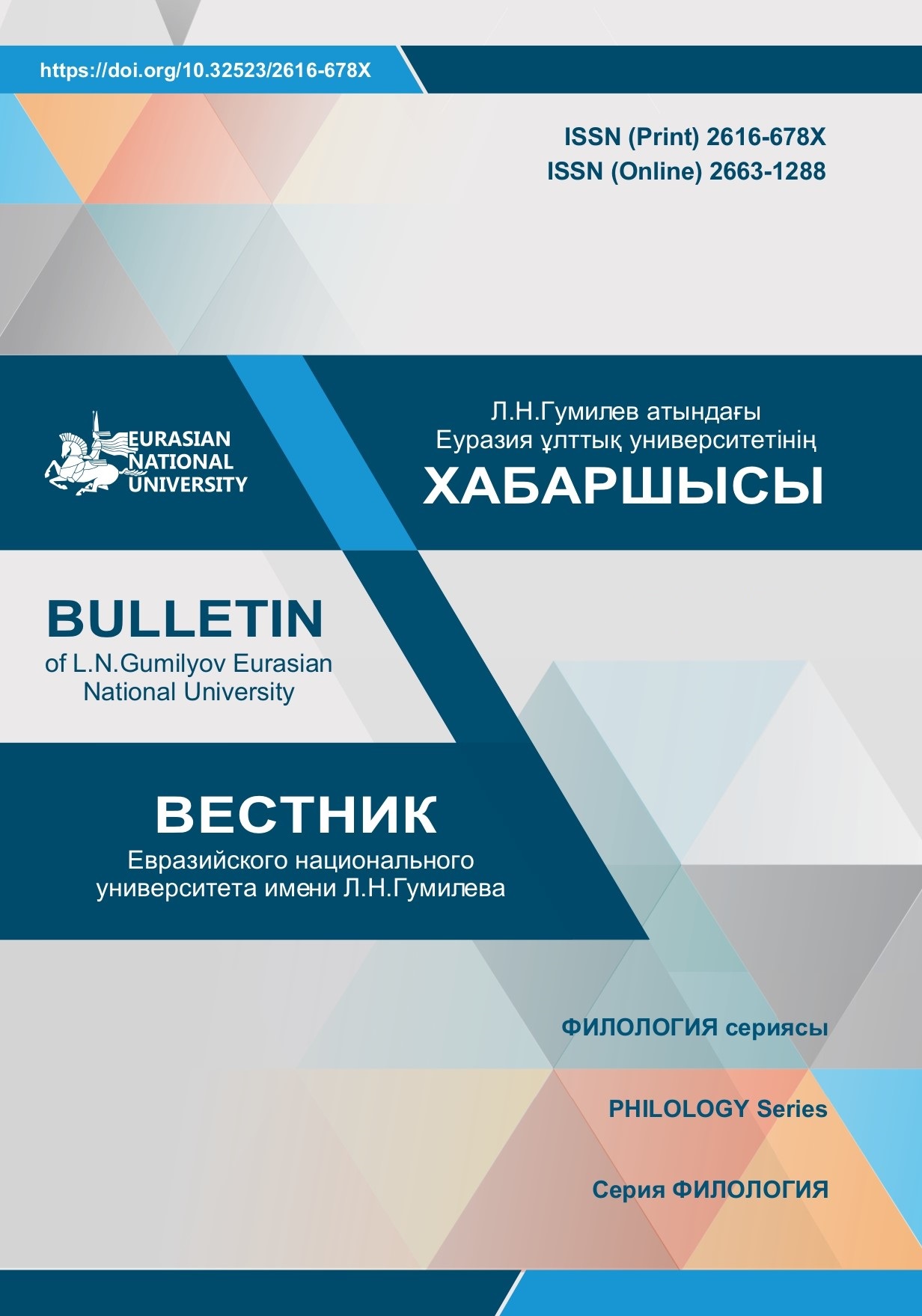
Conceptualization of religion in Linguistic Consciousness of Kazakh Ethnicity
Views: 495 / PDF downloads: 392
DOI:
https://doi.org/10.32523/2616-678X-2022-140-3-32-40Keywords:
linguistic consciousness of Kazakhs, religion, the Kazakh language, nationality, concept, psycholinguistic study, a free associative experiment.Abstract
Religion is the only area where rational-analytical activity, which is obligatory for science, provokes a tense attitude towards itself. In this respect, the identification of religion as a concept, describing its content, structure, and development, as well as its impact on the nation causes a high interest.
The article presents the results of a psycholinguistic study, the purpose of which was to describe the ways of conceptualizing religion by the representatives of the Kazakh language and culture, modeling the associative field “religion” in the Kazakh language, identifying the features of conceptualizing religion in the Kazakh linguistic culture. The material of the research was the data of psycholinguistic study conducted with the native speakers of the Kazakh language. The method of obtaining data was a free associative experiment with the registration of answers given for a certain period of time to the stimulus word дін / religion.
The obtained associative data were distributed according to the frequency criterion, followed by modeling the associative field and its cognitive structure. The associative field “religion” in the Kazakh linguistic consciousness includes agents and artifacts of religion, rituals, beliefs, immaterial aspects, figures, and types of religion. The most frequent associations with religion in the Kazakh linguistic consciousness are мешіт / mosque (13%), Құдай / God (11%), сенім / faith (10%), Ислам / Islam (10%), шіркеу / church (9.5%), Құран / Quran (7.5%), жан / soul (7%), жарық / light (6%), атеизм / atheism (5.5%), дұға ету / pray (5%).
The associative field “religion / дін” modelled as a result of the psycholinguistic study consists of the features ‘Islam’, ‘mosque’, ‘God’, and ‘faith’ in the centre of the field, and the features ‘bata’, ‘pray, ‘zeket’, and ‘oraza’ in the near periphery of the field model “religion / дін”, which demonstrates the relevance of these Islamic religious artifacts and acts to the Kazakh linguistic consciousness.
Downloads
Published
How to Cite
Issue
Section
License
Here is the academic English version suitable for publication on the journal website:
The academic journal “Bulletin of L.N. Gumilyov Eurasian National University. Philology Series” adheres to an Open Access policy for all published materials, based on the principle of free and equitable dissemination of scholarly knowledge. The Editorial Board believes that open access to research results contributes to the advancement of philological science, strengthens academic communication, and promotes the integration of national research into the international scientific community.
1. Free and Open Access
All articles published in the journal are made openly available on the official website of the journal and are accessible to all users without restrictions, registration, or payment.
Users are entitled to:
-
freely read and download materials;
-
copy and distribute the texts of publications;
-
print articles;
-
use materials for scientific and educational purposes, provided that proper attribution is given to the author(s) and the original source of publication.
2. Licensing
Journal materials are distributed under the terms of the Creative Commons Attribution-NonCommercial 4.0 International (CC BY-NC 4.0) license:
https://creativecommons.org/licenses/by-nc/4.0/
This license permits the use, copying, distribution, and adaptation of the materials for non-commercial purposes, provided that appropriate credit is given to the author(s) and a link to the original publication is included.
3. Benefits of Open Access
The Open Access policy ensures:
-
increased visibility and citation of scholarly publications;
-
prompt dissemination of research findings in the fields of philology, linguistics, literary studies, and translation studies;
-
expansion of international academic cooperation;
-
access for readers to up-to-date scientific information without financial or technical barriers.
The Editorial Board is committed to ensuring transparency in editorial processes, maintaining high standards of peer review, and providing broad accessibility to research outcomes in the field of philological studies.