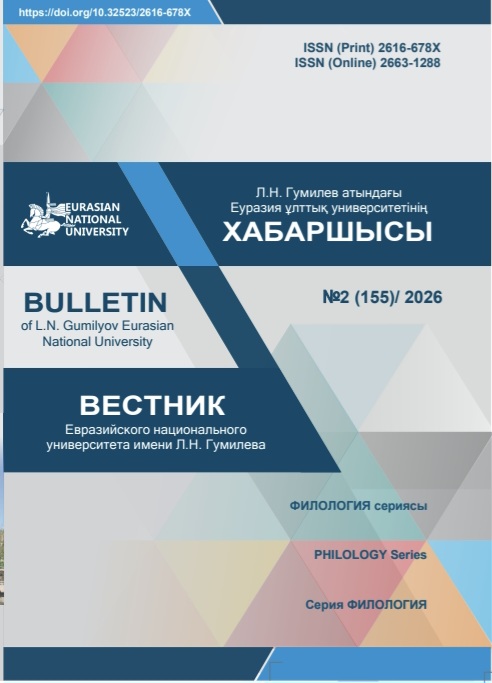
POETICS OF NATIONAL IDENTITY: HISTORICAL MEMORY AND SPIRITUAL TRANSFORMATION IN THE WORKS OF A. ALAKANULY
Views: 192 / PDF downloads: 109
DOI:
https://doi.org/10.32523/2616-678X-2026-155-2-261-280Keywords:
historical memory, spiritual transformation, archetype, chronotope, postcolonial discourse.Abstract
The article analyzes national spirit, historical consciousness, and personal transformation in contemporary Kazakh prose through the archetypal structures and artistic system of A. Alakanyly’s short stories «Ter tamǵan zher» and «Aýyl». The study aims to determine the conceptual foundations of the writer’s poetics by applying artistic-aesthetic and literary-theoretical analysis to themes of national existence, historical memory, and spiritual renewal. The research focuses on the dialectics of historical time and subjective consciousness, the archetypal correlation between national memory and spatial imagery, and the artistic representation of tradition and transformation. Particular attention is given to the unity of space and time, the symbolic system, and psychological characterization as key mechanisms for reconstructing national identity and reviving historical awareness.
Methodologically, the study employs structural, semantic, and poetic analysis. Archetypal analysis reveals the symbolic interconnection between memory and space, while the chronotopic approach clarifies the artistic function of temporal and spatial categories. Symbolic interpretation and psychological-poetic portraiture are used to examine the character’s inner evolution.
The findings demonstrate that in «Ter tamǵan zher» and «Aýyl» the interaction of historical time and subjective consciousness, existential tension, and spiritual rebirth is conveyed through a coherent symbolic and chronotopic structure.
The article proposes a methodological model for exploring national identity through literary texts and advances the study of national poetics, the national spirit, and historical consciousness in contemporary Kazakh prose.
Downloads
Published
How to Cite
Issue
Section
License
Copyright (c) 2026 Bulletin of L.N. Gumilyov Eurasian National University. PHILOLOGY Series

This work is licensed under a Creative Commons Attribution-NonCommercial 4.0 International License.
Here is the academic English version suitable for publication on the journal website:
The academic journal “Bulletin of L.N. Gumilyov Eurasian National University. Philology Series” adheres to an Open Access policy for all published materials, based on the principle of free and equitable dissemination of scholarly knowledge. The Editorial Board believes that open access to research results contributes to the advancement of philological science, strengthens academic communication, and promotes the integration of national research into the international scientific community.
1. Free and Open Access
All articles published in the journal are made openly available on the official website of the journal and are accessible to all users without restrictions, registration, or payment.
Users are entitled to:
-
freely read and download materials;
-
copy and distribute the texts of publications;
-
print articles;
-
use materials for scientific and educational purposes, provided that proper attribution is given to the author(s) and the original source of publication.
2. Licensing
Journal materials are distributed under the terms of the Creative Commons Attribution-NonCommercial 4.0 International (CC BY-NC 4.0) license:
https://creativecommons.org/licenses/by-nc/4.0/
This license permits the use, copying, distribution, and adaptation of the materials for non-commercial purposes, provided that appropriate credit is given to the author(s) and a link to the original publication is included.
3. Benefits of Open Access
The Open Access policy ensures:
-
increased visibility and citation of scholarly publications;
-
prompt dissemination of research findings in the fields of philology, linguistics, literary studies, and translation studies;
-
expansion of international academic cooperation;
-
access for readers to up-to-date scientific information without financial or technical barriers.
The Editorial Board is committed to ensuring transparency in editorial processes, maintaining high standards of peer review, and providing broad accessibility to research outcomes in the field of philological studies.