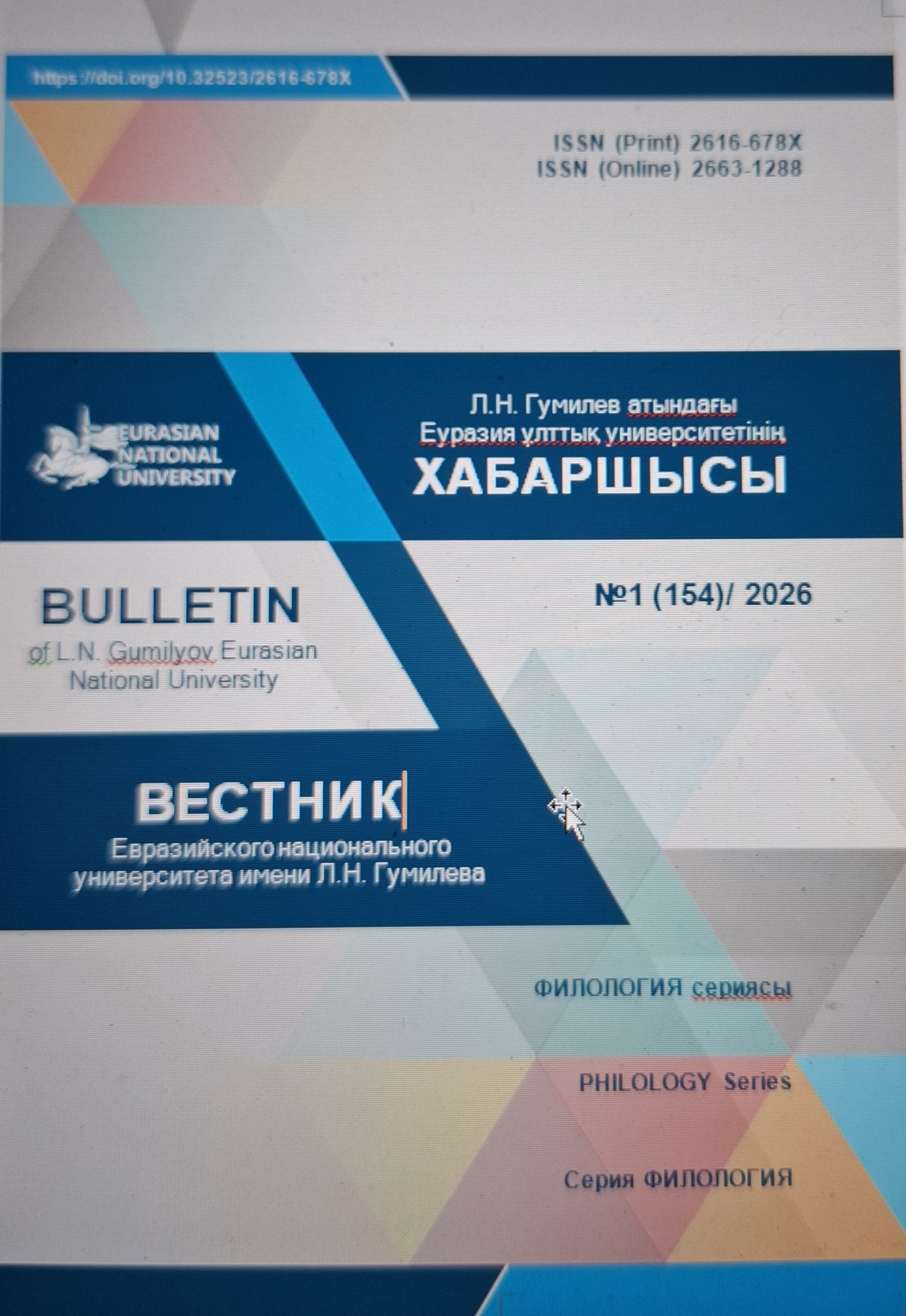
The concept of Mental Lexicon and Modelling Practices in Interdisciplinary Research
Views: 308 / PDF downloads: 128
DOI:
https://doi.org/10.32523/2616-678X-2026-154-1-122-140Keywords:
mental lexicon, lexical representation, lexical access, ontogenesis, bilingualism, semantic network, associative networkAbstract
This paper examines the mental lexicon as an interdisciplinary construct at the intersection of psycholinguistics, cognitive linguistics, and neuroscience, and systematizes key approaches to its modelling. It argues that the mental lexicon should be understood not as a static “word store,” but as a dynamic system underlying speech comprehension and production. The study integrates evidence on the component structure of lexical representations, including form–meaning relations and lemma–lexeme distinctions, as well as developmental changes and bilingual processing, within a unified framework. An integrative review methodology is employed, combining content analysis and comparative evaluation of international and regional research, alongside findings from established experimental paradigms such as word association, priming, tip-of-the-tongue phenomena, eye-tracking, and neuroimaging. The results suggest that the mental lexicon consists of interconnected semantic, phonological, and orthographic layers, where lexical access depends on representational quality, connection strength, and network integration. Developmental changes involve both vocabulary expansion and structural reorganization of lexical networks, including the formation of core–periphery patterns. In bilinguals, parallel language activation and control mechanisms increase lexical competition and may reduce accessibility of certain units. The study highlights network-based models as a promising integrative approach and emphasizes the need for expanded empirical resources..
Downloads
Published
How to Cite
Issue
Section
License
Copyright (c) 2026 Bulletin of L.N. Gumilyov Eurasian National University. PHILOLOGY Series

This work is licensed under a Creative Commons Attribution-NonCommercial 4.0 International License.
Here is the academic English version suitable for publication on the journal website:
The academic journal “Bulletin of L.N. Gumilyov Eurasian National University. Philology Series” adheres to an Open Access policy for all published materials, based on the principle of free and equitable dissemination of scholarly knowledge. The Editorial Board believes that open access to research results contributes to the advancement of philological science, strengthens academic communication, and promotes the integration of national research into the international scientific community.
1. Free and Open Access
All articles published in the journal are made openly available on the official website of the journal and are accessible to all users without restrictions, registration, or payment.
Users are entitled to:
-
freely read and download materials;
-
copy and distribute the texts of publications;
-
print articles;
-
use materials for scientific and educational purposes, provided that proper attribution is given to the author(s) and the original source of publication.
2. Licensing
Journal materials are distributed under the terms of the Creative Commons Attribution-NonCommercial 4.0 International (CC BY-NC 4.0) license:
https://creativecommons.org/licenses/by-nc/4.0/
This license permits the use, copying, distribution, and adaptation of the materials for non-commercial purposes, provided that appropriate credit is given to the author(s) and a link to the original publication is included.
3. Benefits of Open Access
The Open Access policy ensures:
-
increased visibility and citation of scholarly publications;
-
prompt dissemination of research findings in the fields of philology, linguistics, literary studies, and translation studies;
-
expansion of international academic cooperation;
-
access for readers to up-to-date scientific information without financial or technical barriers.
The Editorial Board is committed to ensuring transparency in editorial processes, maintaining high standards of peer review, and providing broad accessibility to research outcomes in the field of philological studies.