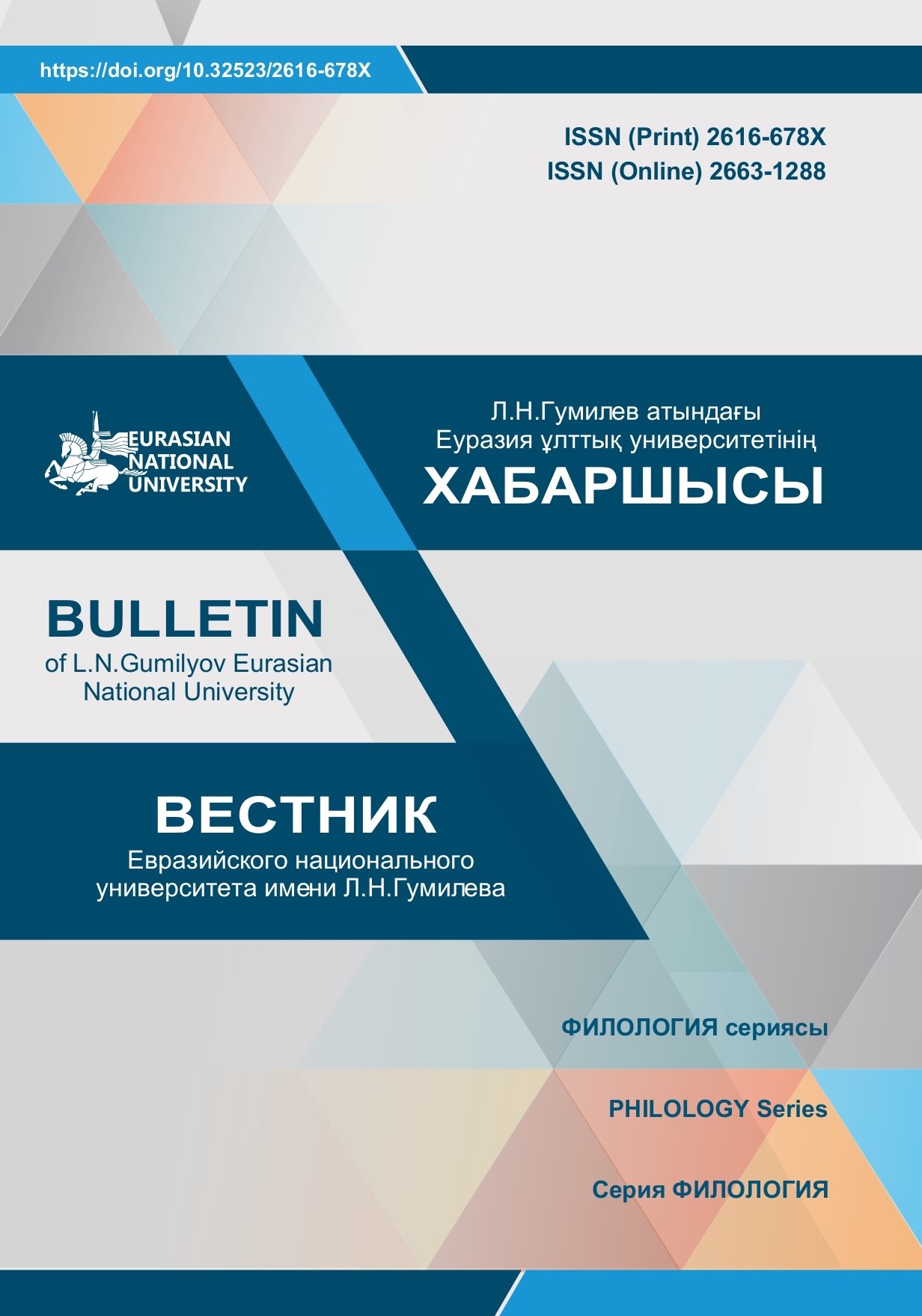
Motive «Zher asty alemine sayachattay» («A travel to the underground world») in fairy tales
Views: 355 / PDF downloads: 187
DOI:
https://doi.org/10.32523/2616-678X-2019-127-2-8-14Keywords:
heroic tale, underground world, mythical motif, folklore, Samruk bird, Baiterek, dragon imageAbstract
In the article, the main object is the motive of traveling to the underworld of the main
character in heroic fairy tales. Particular attention is paid to the repetition of the storyline in the fairy
tale and on the character of the national heroes. In heroic fairy tales, the symbolic meaning of the most
frequently repeated images of Samruk bird, Baiterek, Dragon is shown and an analysis is made of the fact that these three elements have become traditional motifs. According to the mythical knowledge, the
repetition of the storyline in Kazakh heroic fairy tales and in fairy tales of other nations, the images of
Samruk bird, Baiterek, Dragon, is shown on the basis of a comparative analysis. We consider the stable
ideas of mythopoetic consciousness, mythical knowledge, mythical motifs and images in the content of
heroic fairy tales. Conclusions are made on the basis of the analysis of the connection of storylines and
mythical motifs in fairy tales preserved from ancient times
Downloads
Published
How to Cite
Issue
Section
License
Here is the academic English version suitable for publication on the journal website:
The academic journal “Bulletin of L.N. Gumilyov Eurasian National University. Philology Series” adheres to an Open Access policy for all published materials, based on the principle of free and equitable dissemination of scholarly knowledge. The Editorial Board believes that open access to research results contributes to the advancement of philological science, strengthens academic communication, and promotes the integration of national research into the international scientific community.
1. Free and Open Access
All articles published in the journal are made openly available on the official website of the journal and are accessible to all users without restrictions, registration, or payment.
Users are entitled to:
-
freely read and download materials;
-
copy and distribute the texts of publications;
-
print articles;
-
use materials for scientific and educational purposes, provided that proper attribution is given to the author(s) and the original source of publication.
2. Licensing
Journal materials are distributed under the terms of the Creative Commons Attribution-NonCommercial 4.0 International (CC BY-NC 4.0) license:
https://creativecommons.org/licenses/by-nc/4.0/
This license permits the use, copying, distribution, and adaptation of the materials for non-commercial purposes, provided that appropriate credit is given to the author(s) and a link to the original publication is included.
3. Benefits of Open Access
The Open Access policy ensures:
-
increased visibility and citation of scholarly publications;
-
prompt dissemination of research findings in the fields of philology, linguistics, literary studies, and translation studies;
-
expansion of international academic cooperation;
-
access for readers to up-to-date scientific information without financial or technical barriers.
The Editorial Board is committed to ensuring transparency in editorial processes, maintaining high standards of peer review, and providing broad accessibility to research outcomes in the field of philological studies.