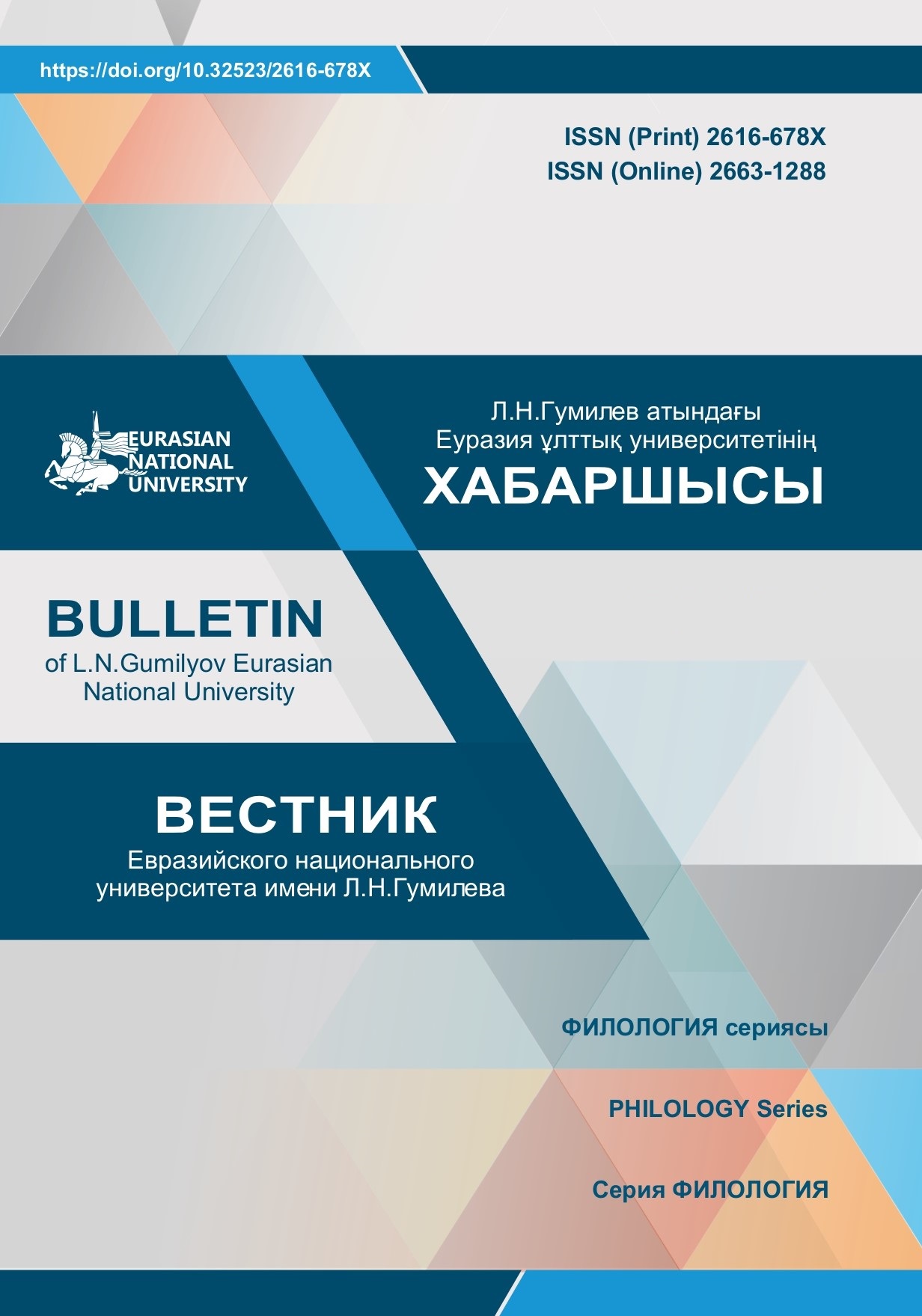
Problems of ecology of personality as a subject of a literary text (based on the material of N. Verevochkin’s novel Mammoth Tooth. Chronicle of the Dead City)
Views: 381 / PDF downloads: 504
DOI:
https://doi.org/10.32523/2616-678X-2023-143-2-122-131Keywords:
personality ecology, postmodernism, deficiency hero, Nikolay VerevochkinAbstract
This article is devoted to an actual interdisciplinary problem - the ecology of personality
in the context of the literary approach. Personal ecology, which studies the phenomenon of individual
mental structure, is currently developing in several directions - from pan-ecological, when an individual
is comprehended as part of the environment, to psychological, when his unique personal characteristics
participate in the flow of subjective interactional processes. Literature can also become material for the
study of this phenomenon. A literary text, whose subject organization is data for analysis, provides us with
types of personalities that it is advisable to study from the point of view of personal ecology. In this work,
we tried to demonstrate this using the example of a postmodern text - N. Verevochkin’s work Mammoth’s
Tooth. Chronicle of the Dead City. The protagonist of the novel is a classic example of a deficient personality
who overcomes his own negative attitudes in the context of a new social environment for himself. Using
the method of mythopoetic analysis and psychological commentary, we came to the conclusion that the
hero of modern Kazakhstani prose is a person with a disturbed internal ecology, which can be restored
only by certain circumstances (explicated by us at the level of the plot).
Downloads
Published
How to Cite
Issue
Section
License
Here is the academic English version suitable for publication on the journal website:
The academic journal “Bulletin of L.N. Gumilyov Eurasian National University. Philology Series” adheres to an Open Access policy for all published materials, based on the principle of free and equitable dissemination of scholarly knowledge. The Editorial Board believes that open access to research results contributes to the advancement of philological science, strengthens academic communication, and promotes the integration of national research into the international scientific community.
1. Free and Open Access
All articles published in the journal are made openly available on the official website of the journal and are accessible to all users without restrictions, registration, or payment.
Users are entitled to:
-
freely read and download materials;
-
copy and distribute the texts of publications;
-
print articles;
-
use materials for scientific and educational purposes, provided that proper attribution is given to the author(s) and the original source of publication.
2. Licensing
Journal materials are distributed under the terms of the Creative Commons Attribution-NonCommercial 4.0 International (CC BY-NC 4.0) license:
https://creativecommons.org/licenses/by-nc/4.0/
This license permits the use, copying, distribution, and adaptation of the materials for non-commercial purposes, provided that appropriate credit is given to the author(s) and a link to the original publication is included.
3. Benefits of Open Access
The Open Access policy ensures:
-
increased visibility and citation of scholarly publications;
-
prompt dissemination of research findings in the fields of philology, linguistics, literary studies, and translation studies;
-
expansion of international academic cooperation;
-
access for readers to up-to-date scientific information without financial or technical barriers.
The Editorial Board is committed to ensuring transparency in editorial processes, maintaining high standards of peer review, and providing broad accessibility to research outcomes in the field of philological studies.