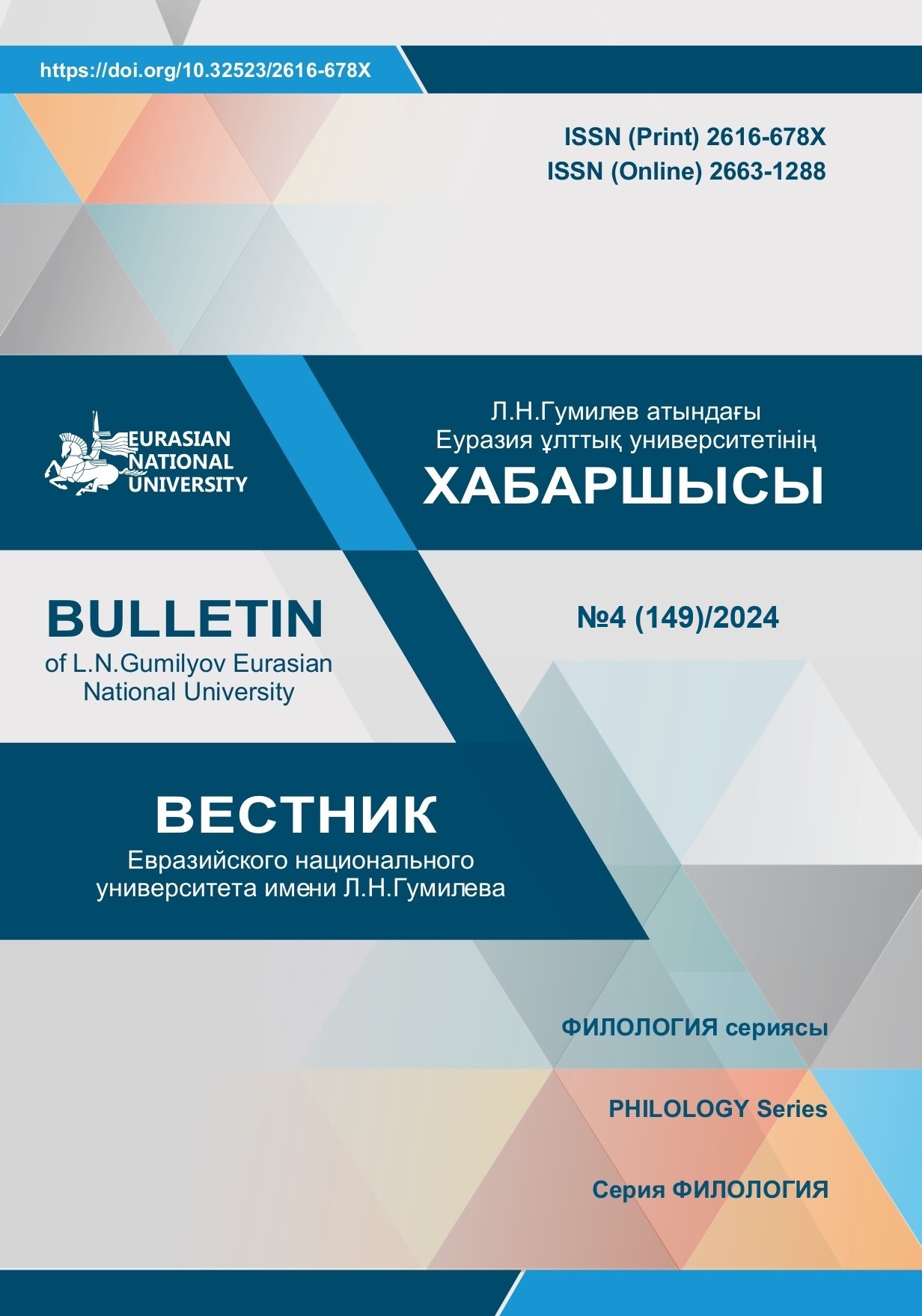
Creative portrait of Nikolai Gumilyov, created by contemporary artists: style and synthesis
Views: 439 / PDF downloads: 227
DOI:
https://doi.org/10.32523/2616-678X-2024-149-4-166-174Keywords:
lyric poetry, ХХth-century poetry, author's worldview, artistic image, literary device, genre.Abstract
The figure of Nikolai Stepanovich Gumilyov, a poet and theorist of Acmeism, possesses a unique allure and depth. His legacy comprises a creative self-portrait, as well as portraits created by his contemporaries: poets and painters. The aim of this study is to reproduce the artistic portrait of Nikolai Gumilyov, crafted by masters of various arts who, while capturing the distinctive qualities of the poet, also expressed traits of the “style of the cultural epoch” (P.N. Sakulin) to which he belonged. To reveal the individuality in the creation of the poet's image, the painter or poet must employ means that can most accurately and expressively describe the real personality and spiritual essence of the subject being portrayed. To achieve this, a comparative-historical method developed by F.I. Buslaev and further applied by the prominent literary theorist and poetry researcher of the turn of the 20th century, V.M. Zhirmunsky. This research enables the identification of the common and individual elements in each specific case and presents the characteristics of the complex and tragic epoch of the early 20th century.
Downloads
Published
How to Cite
Issue
Section
License
Here is the academic English version suitable for publication on the journal website:
The academic journal “Bulletin of L.N. Gumilyov Eurasian National University. Philology Series” adheres to an Open Access policy for all published materials, based on the principle of free and equitable dissemination of scholarly knowledge. The Editorial Board believes that open access to research results contributes to the advancement of philological science, strengthens academic communication, and promotes the integration of national research into the international scientific community.
1. Free and Open Access
All articles published in the journal are made openly available on the official website of the journal and are accessible to all users without restrictions, registration, or payment.
Users are entitled to:
-
freely read and download materials;
-
copy and distribute the texts of publications;
-
print articles;
-
use materials for scientific and educational purposes, provided that proper attribution is given to the author(s) and the original source of publication.
2. Licensing
Journal materials are distributed under the terms of the Creative Commons Attribution-NonCommercial 4.0 International (CC BY-NC 4.0) license:
https://creativecommons.org/licenses/by-nc/4.0/
This license permits the use, copying, distribution, and adaptation of the materials for non-commercial purposes, provided that appropriate credit is given to the author(s) and a link to the original publication is included.
3. Benefits of Open Access
The Open Access policy ensures:
-
increased visibility and citation of scholarly publications;
-
prompt dissemination of research findings in the fields of philology, linguistics, literary studies, and translation studies;
-
expansion of international academic cooperation;
-
access for readers to up-to-date scientific information without financial or technical barriers.
The Editorial Board is committed to ensuring transparency in editorial processes, maintaining high standards of peer review, and providing broad accessibility to research outcomes in the field of philological studies.