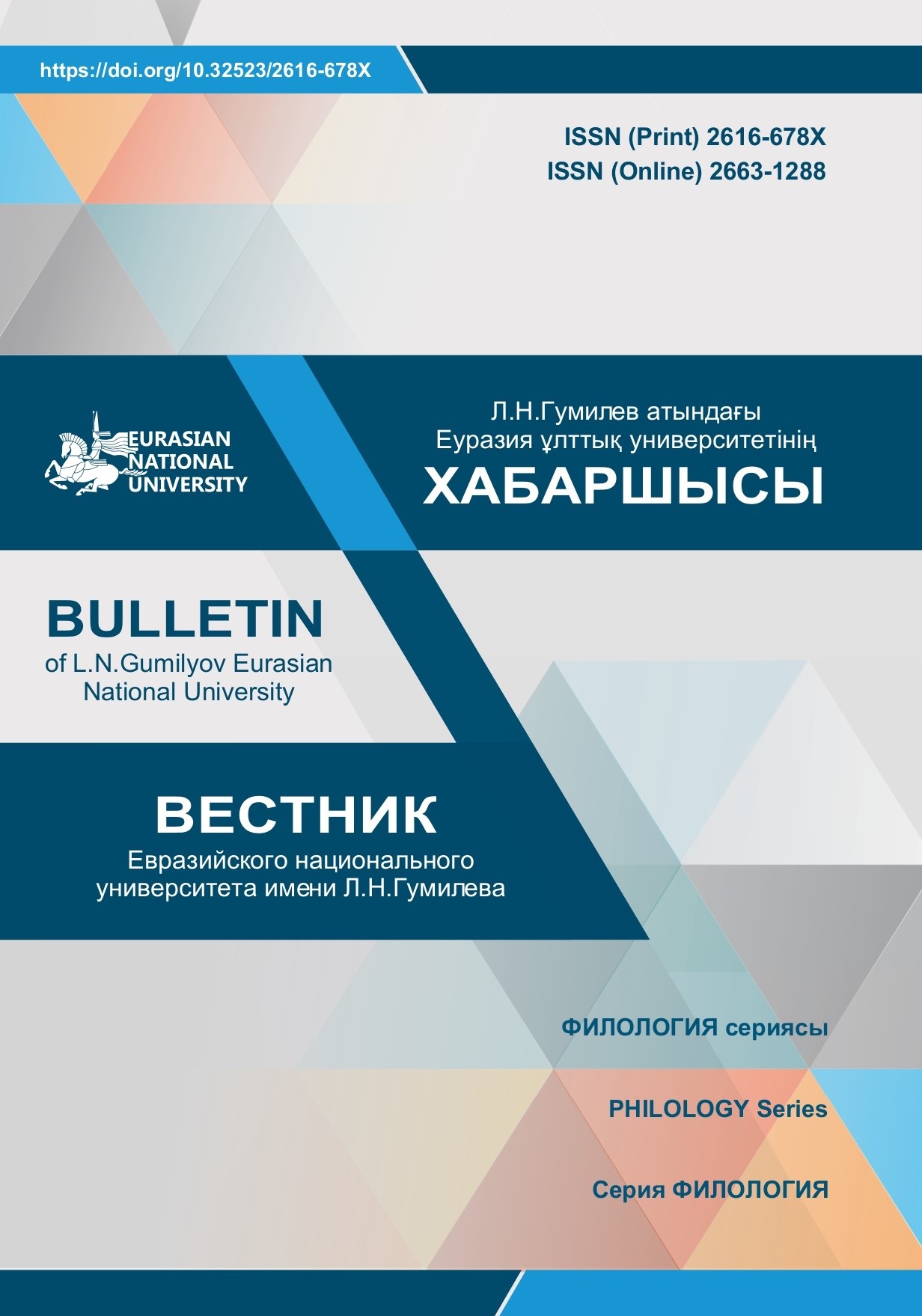
Semantic field of the subconcept «power» in the Kazakh paremiological space
Views: 538 / PDF downloads: 431
DOI:
https://doi.org/10.32523/2616-678X-2024-147-2-8-17Keywords:
Paremiology, concept, linguoculturology, power system, proverbs and sayings.Abstract
The article analyzes the semantic field of the subcortex «power» in the Kazakh paremiological space. Power is the regulator of Public Relations. Therefore, it also plays an important role in the formation of folk experience and values, the system of folk thinking, the principles of life, and the form of life.
Consequently, the topic of power does not lose its relevance at any stage. At the same time, the description of the nature of the concept of «power» in Kazakh knowledge from the point of view of the paremiological
system allows us to achieve important results. After all, the paremiological space also accumulates patterns of tastes and experiences inherent in a particular population.
The purpose of the study is to examine the semantic field in the paremiological space of existing concepts and notions related to «power» in traditional Kazakh society. The nature of the semantic units that make up the subcept «power» in the composition of Proverbs and sayings and their significance in
public life are analyzed. The essence of the language units representing the system of government of the Kazakh people in the paremiological system is revealed, and the lexemes that make up the semantic field
of the «power» subconcept are identified. The study also focuses on the historical, ethnographic and sociocultural
context that forms the concepts of power in the collective consciousness of the Kazakh people.
The results obtained make it possible to more deeply understand and explain the meanings inherent in the subcept «power» in the framework of Kazakh paremiology, to reveal the specific nature of the cultural characteristics of the Kazakh people. The findings of the study are considered additional material for specialists in this direction and in the humanitarian field.
Downloads
Published
How to Cite
Issue
Section
License
Here is the academic English version suitable for publication on the journal website:
The academic journal “Bulletin of L.N. Gumilyov Eurasian National University. Philology Series” adheres to an Open Access policy for all published materials, based on the principle of free and equitable dissemination of scholarly knowledge. The Editorial Board believes that open access to research results contributes to the advancement of philological science, strengthens academic communication, and promotes the integration of national research into the international scientific community.
1. Free and Open Access
All articles published in the journal are made openly available on the official website of the journal and are accessible to all users without restrictions, registration, or payment.
Users are entitled to:
-
freely read and download materials;
-
copy and distribute the texts of publications;
-
print articles;
-
use materials for scientific and educational purposes, provided that proper attribution is given to the author(s) and the original source of publication.
2. Licensing
Journal materials are distributed under the terms of the Creative Commons Attribution-NonCommercial 4.0 International (CC BY-NC 4.0) license:
https://creativecommons.org/licenses/by-nc/4.0/
This license permits the use, copying, distribution, and adaptation of the materials for non-commercial purposes, provided that appropriate credit is given to the author(s) and a link to the original publication is included.
3. Benefits of Open Access
The Open Access policy ensures:
-
increased visibility and citation of scholarly publications;
-
prompt dissemination of research findings in the fields of philology, linguistics, literary studies, and translation studies;
-
expansion of international academic cooperation;
-
access for readers to up-to-date scientific information without financial or technical barriers.
The Editorial Board is committed to ensuring transparency in editorial processes, maintaining high standards of peer review, and providing broad accessibility to research outcomes in the field of philological studies.