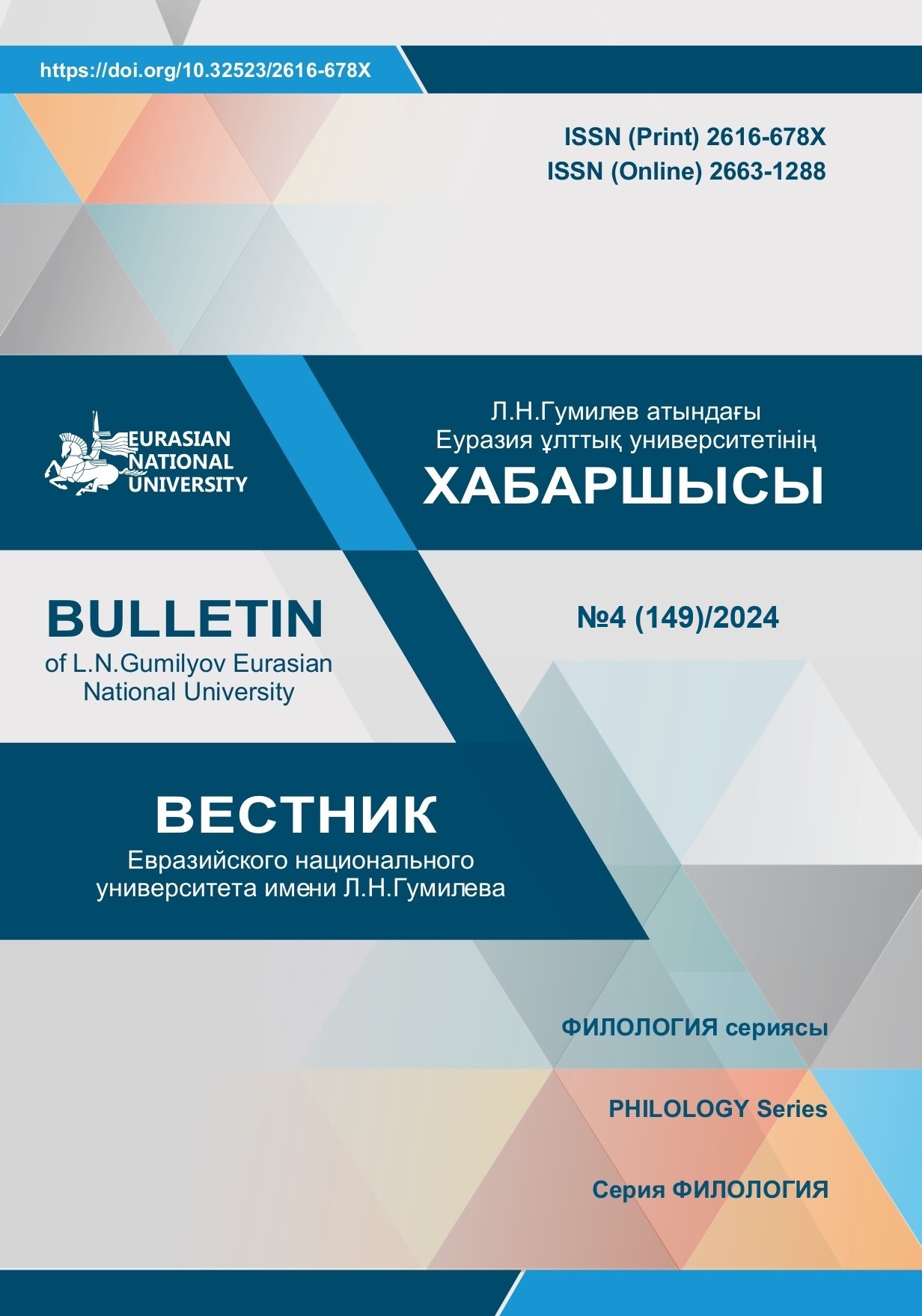
Typological similarities in the folclore tradition of the Persian-Turkic peoples
Views: 442 / PDF downloads: 373
DOI:
https://doi.org/10.32523/2616-678X-2024-149-4-175-183Keywords:
folklore, typology, genre, analogy, love poems, tradition.Abstract
The article describes the spiritual harmonies occurring in the succession of epochs. An urgent problem of our time is to determine the place and assessment of the Turkic worldviews and positions of the Kazakh people in folklore. Kissas, poems, love poems, heroic poems, etc., which represent the totality of the wealth of the Turkic world, also have a special character in the world civilization. In the course of studying their historical and structural nature, a number of scientists who have undergone numerous discoveries began to pay attention to the continuity and typological similarity of folklore traditions. The option that began in past eras has not lost its value today. It is noteworthy that the philosophy and psychology of the characters run in parallel, based on the traditions of a dual civilization. In the main part, it turns out that the cult in the folklore tradition of the Persian-Turkic peoples is common. In the author's view, it is clear how many forms of transmission of religion and culture rely on mastery. The "golden Bridge" between two civilized societies is what brings discoveries and benefits to the life of mankind. The opinions of a number of our researchers will be summarized and additional clarifications will be given. The final part provides a clear definition of how close the connection between authenticity and folklore is, which has become the subject of world science research. Folklore tradition has become an independent genre and has become a source of spiritual wealth of the people. After all, folklore is intertwined with folk traditions.
Downloads
Published
How to Cite
Issue
Section
License
Here is the academic English version suitable for publication on the journal website:
The academic journal “Bulletin of L.N. Gumilyov Eurasian National University. Philology Series” adheres to an Open Access policy for all published materials, based on the principle of free and equitable dissemination of scholarly knowledge. The Editorial Board believes that open access to research results contributes to the advancement of philological science, strengthens academic communication, and promotes the integration of national research into the international scientific community.
1. Free and Open Access
All articles published in the journal are made openly available on the official website of the journal and are accessible to all users without restrictions, registration, or payment.
Users are entitled to:
-
freely read and download materials;
-
copy and distribute the texts of publications;
-
print articles;
-
use materials for scientific and educational purposes, provided that proper attribution is given to the author(s) and the original source of publication.
2. Licensing
Journal materials are distributed under the terms of the Creative Commons Attribution-NonCommercial 4.0 International (CC BY-NC 4.0) license:
https://creativecommons.org/licenses/by-nc/4.0/
This license permits the use, copying, distribution, and adaptation of the materials for non-commercial purposes, provided that appropriate credit is given to the author(s) and a link to the original publication is included.
3. Benefits of Open Access
The Open Access policy ensures:
-
increased visibility and citation of scholarly publications;
-
prompt dissemination of research findings in the fields of philology, linguistics, literary studies, and translation studies;
-
expansion of international academic cooperation;
-
access for readers to up-to-date scientific information without financial or technical barriers.
The Editorial Board is committed to ensuring transparency in editorial processes, maintaining high standards of peer review, and providing broad accessibility to research outcomes in the field of philological studies.