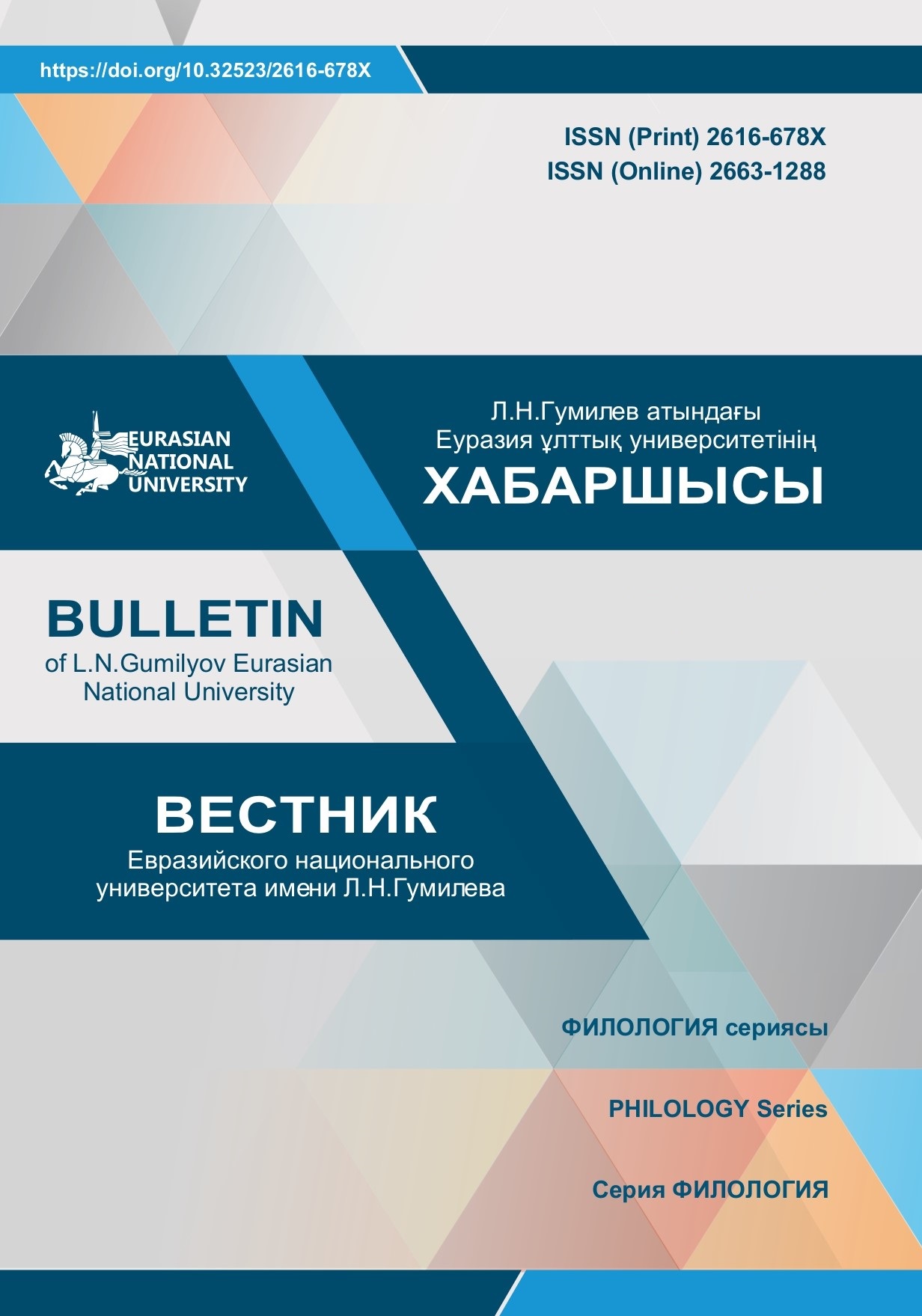
Brief characteristics of proper names
Views: 513 / PDF downloads: 886
DOI:
https://doi.org/10.32523/2616-678X-2023-145-4-19-34Keywords:
anthropology, onomastics, human identification, etymological analysis, society, the evolution of proper name, cultureAbstract
Anthroponymy is indeed the study of anthroponyms, which are personal names given to individuals or groups of people. Understanding how to express the semantic features of personal names in dictionaries is crucial for accurately capturing and conveying the diverse meanings and cultural nuances associated with names.
Thus, we have conducted a comprehensive study on anthroponymy, specifically focusing on the general characteristics of proper names briefly referring to some examples in Kazakh, British English, and American English. By consulting various works dedicated to anthropology and linguistics, we have likely gathered valuable insights into the anthroponymic systems of some cultures and languages. The use of tables and figures can be helpful in presenting and analyzing data related to the characteristics of names. Furthermore, our analysis of unisex proper names in Great Britain and Kazakhstan for the year 2023 adds a contemporary and specific dimension to the given research.
Overall, this article appears to offer a brief exploration of personal names, incorporating general characteristics, cultural identity, and contemporary analysis. This descriptive approach is likely to provide readers with valuable insights into the types and trends of proper names in English-speaking countries and Kazakhstan.
Downloads
Published
How to Cite
Issue
Section
License
Here is the academic English version suitable for publication on the journal website:
The academic journal “Bulletin of L.N. Gumilyov Eurasian National University. Philology Series” adheres to an Open Access policy for all published materials, based on the principle of free and equitable dissemination of scholarly knowledge. The Editorial Board believes that open access to research results contributes to the advancement of philological science, strengthens academic communication, and promotes the integration of national research into the international scientific community.
1. Free and Open Access
All articles published in the journal are made openly available on the official website of the journal and are accessible to all users without restrictions, registration, or payment.
Users are entitled to:
-
freely read and download materials;
-
copy and distribute the texts of publications;
-
print articles;
-
use materials for scientific and educational purposes, provided that proper attribution is given to the author(s) and the original source of publication.
2. Licensing
Journal materials are distributed under the terms of the Creative Commons Attribution-NonCommercial 4.0 International (CC BY-NC 4.0) license:
https://creativecommons.org/licenses/by-nc/4.0/
This license permits the use, copying, distribution, and adaptation of the materials for non-commercial purposes, provided that appropriate credit is given to the author(s) and a link to the original publication is included.
3. Benefits of Open Access
The Open Access policy ensures:
-
increased visibility and citation of scholarly publications;
-
prompt dissemination of research findings in the fields of philology, linguistics, literary studies, and translation studies;
-
expansion of international academic cooperation;
-
access for readers to up-to-date scientific information without financial or technical barriers.
The Editorial Board is committed to ensuring transparency in editorial processes, maintaining high standards of peer review, and providing broad accessibility to research outcomes in the field of philological studies.