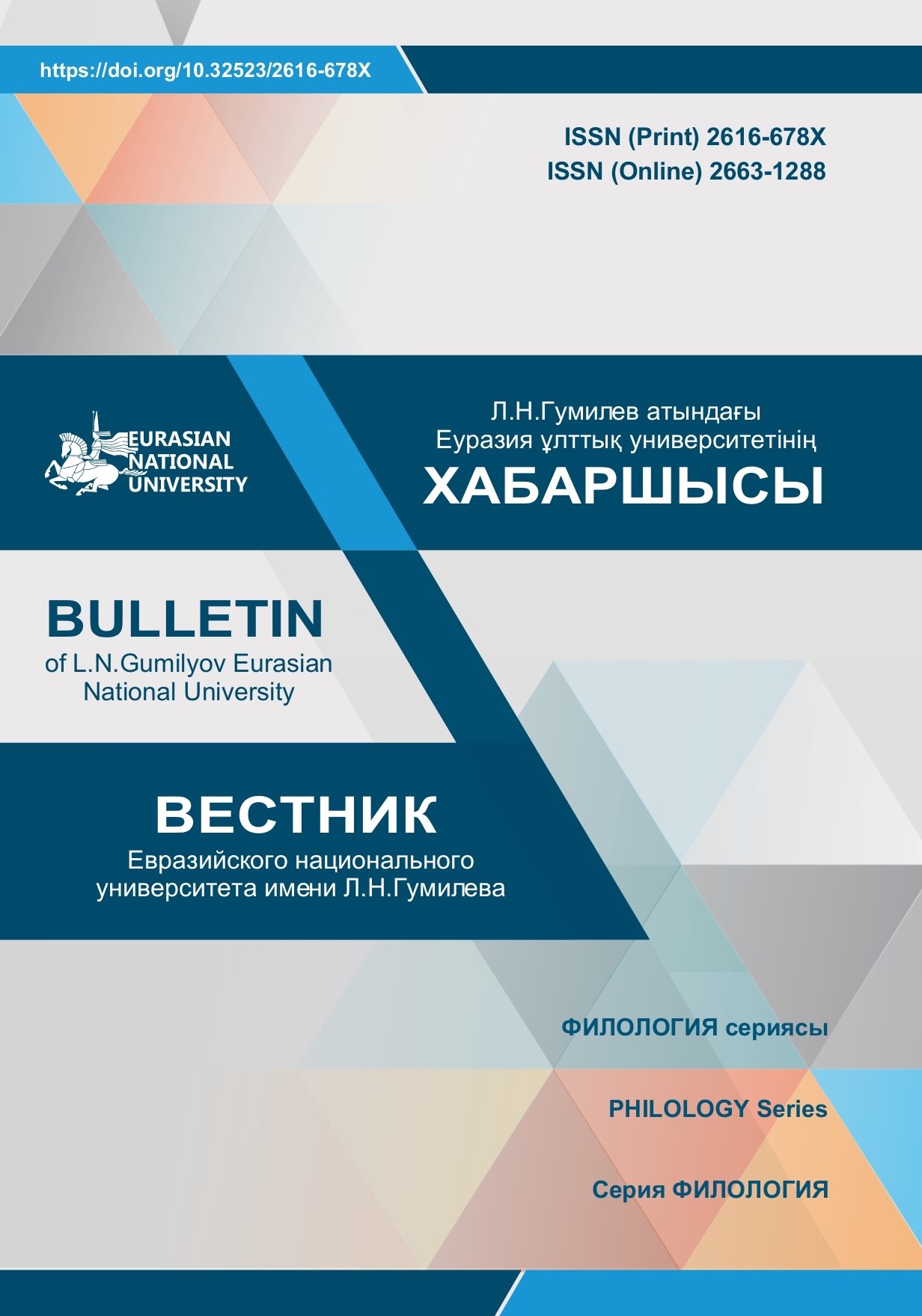
Folkloric motives in modern Kazakh prose
Views: 335 / PDF downloads: 370
DOI:
https://doi.org/10.32523/2616-678X-2019-127-2-36-44Keywords:
prose, folk motive, traditional folklore, ethno-folklore, national cognitionAbstract
The article describes some folkloric motives in modern Kazakh prose. From a scientific
point of view, folkloric knowledge was created on the basis of each of the works. Also, the folklore of modern
Kazakh prose is revival and artistry. Separation of fiction from other art forms itself is a multidimensional
character. Among them folklore is unique. The historical relationship between folklore and literature is
one of the most important aspects of the development of world literature. Literature turns to folklore in
every era, and it is the only way to demonstrate the complex historical legitimacy, the attention of poets,
writers to the real, historic, significant stages of folklore. Folklore and literature are two aesthetic systems.
That’s why the means for recognizing both of them are not the same. The relationship between folklore
and literature has always been different in each era. In some eras, this process is slowing, and in some eras
it slows down. Nevertheless, the interaction between literature and folklore continued. Today’s literature
also focuses on folk traditions, its artistic nature.
Folklore works are a form of long-term knowledge of our people
Downloads
Published
How to Cite
Issue
Section
License
Here is the academic English version suitable for publication on the journal website:
The academic journal “Bulletin of L.N. Gumilyov Eurasian National University. Philology Series” adheres to an Open Access policy for all published materials, based on the principle of free and equitable dissemination of scholarly knowledge. The Editorial Board believes that open access to research results contributes to the advancement of philological science, strengthens academic communication, and promotes the integration of national research into the international scientific community.
1. Free and Open Access
All articles published in the journal are made openly available on the official website of the journal and are accessible to all users without restrictions, registration, or payment.
Users are entitled to:
-
freely read and download materials;
-
copy and distribute the texts of publications;
-
print articles;
-
use materials for scientific and educational purposes, provided that proper attribution is given to the author(s) and the original source of publication.
2. Licensing
Journal materials are distributed under the terms of the Creative Commons Attribution-NonCommercial 4.0 International (CC BY-NC 4.0) license:
https://creativecommons.org/licenses/by-nc/4.0/
This license permits the use, copying, distribution, and adaptation of the materials for non-commercial purposes, provided that appropriate credit is given to the author(s) and a link to the original publication is included.
3. Benefits of Open Access
The Open Access policy ensures:
-
increased visibility and citation of scholarly publications;
-
prompt dissemination of research findings in the fields of philology, linguistics, literary studies, and translation studies;
-
expansion of international academic cooperation;
-
access for readers to up-to-date scientific information without financial or technical barriers.
The Editorial Board is committed to ensuring transparency in editorial processes, maintaining high standards of peer review, and providing broad accessibility to research outcomes in the field of philological studies.