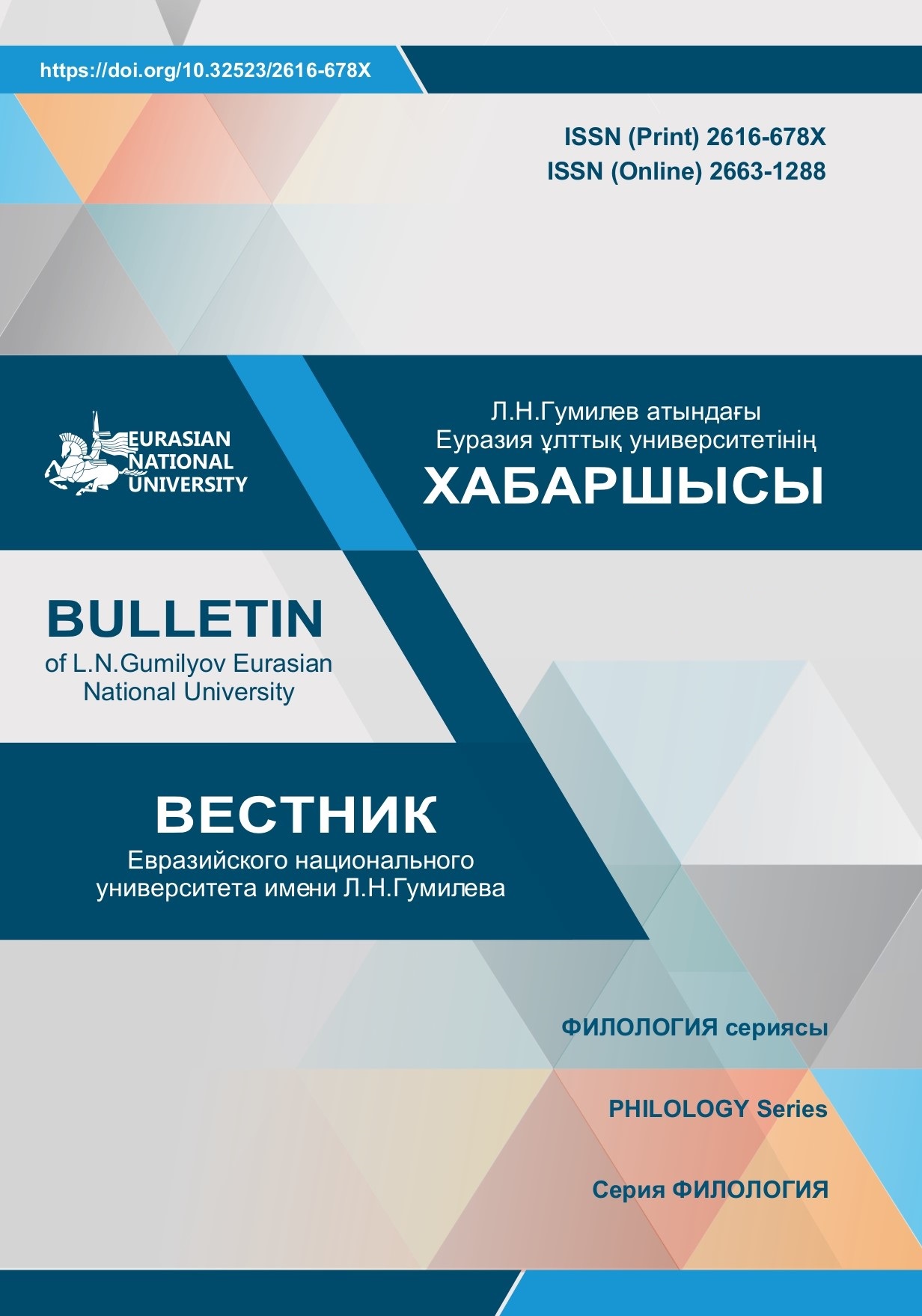
Russian Universum of Quranic Poetology
Views: 208 / PDF downloads: 139
DOI:
https://doi.org/10.32523/2616-678X-2018-122-1-95-104Keywords:
A.S. Pushkin, Ya.P. Polonsky, I.A. Bunin, K.D. Balmont, the Creator, the Koran, the spiritual-biographical, collisions, the symbol, the demiurgic, the archetype, the chronotope of the pathAbstract
The proposed articledefines and considers samples of Russian poetry of the middle
and the beginning of the 20th centuries, going back to the “Imitations of the Koran” by A.S. Pushkin. In
the process of analysis, the topic of the prophet and his revelations, the chronotope of the hero’s way and
the reality surrounding him, are actualized. In this interpretation, the structural and semantic features
of Russian Qoranic poetry are relevant: the motifs of creation, the three-part picture of the world, the
elements of solar mythology, the tanatological landscape, the calming symbolism of water, the archetype of
paradise, which is the metaphor of hedonistic bliss, the desert of the night, constructing the situation of the
phenomenon of angels,
The urgency of the literary criticism problem, which was taken into the title of the article, is
affirmed. The aspects of subsequent research are modeled.
Downloads
Published
How to Cite
Issue
Section
License
Here is the academic English version suitable for publication on the journal website:
The academic journal “Bulletin of L.N. Gumilyov Eurasian National University. Philology Series” adheres to an Open Access policy for all published materials, based on the principle of free and equitable dissemination of scholarly knowledge. The Editorial Board believes that open access to research results contributes to the advancement of philological science, strengthens academic communication, and promotes the integration of national research into the international scientific community.
1. Free and Open Access
All articles published in the journal are made openly available on the official website of the journal and are accessible to all users without restrictions, registration, or payment.
Users are entitled to:
-
freely read and download materials;
-
copy and distribute the texts of publications;
-
print articles;
-
use materials for scientific and educational purposes, provided that proper attribution is given to the author(s) and the original source of publication.
2. Licensing
Journal materials are distributed under the terms of the Creative Commons Attribution-NonCommercial 4.0 International (CC BY-NC 4.0) license:
https://creativecommons.org/licenses/by-nc/4.0/
This license permits the use, copying, distribution, and adaptation of the materials for non-commercial purposes, provided that appropriate credit is given to the author(s) and a link to the original publication is included.
3. Benefits of Open Access
The Open Access policy ensures:
-
increased visibility and citation of scholarly publications;
-
prompt dissemination of research findings in the fields of philology, linguistics, literary studies, and translation studies;
-
expansion of international academic cooperation;
-
access for readers to up-to-date scientific information without financial or technical barriers.
The Editorial Board is committed to ensuring transparency in editorial processes, maintaining high standards of peer review, and providing broad accessibility to research outcomes in the field of philological studies.